


| Share: |
Facebook |
|
Twitter
X |
|
|
|
Steppe in Africa on Oct 23, 2022: Pioneer Tony Rinaudo: Shrubs are stunted trees - they just need to be care and the trees are back:
Planting trees against climate change – is it really that simple?
(orig. German: Bäume pflanzen gegen den Klimawandel – ist es wirklich so einfach?)
https://www.nau.ch/blog/charity_partner/baume-pflanzen-gegen-den-klimawandel-ist-es-wirklich-so-einfach-66306360
Photo text: Re-greening desertified soils is beneficial for the climate and enhances the quality of life for people.
Steppe in Africa on Oct 23, 2022: Pioneer Mr. Tony Rinaudo: Shrubs are stunted trees - you just have to care for them properly and the trees will return [1]
A simple method for environmental regeneration
The preservation of natural resources is a fundamental prerequisite for sustainability and the quality of life of people.
A promising approach is the re-greening of degraded soils. The FMNR method, "Farmer-Managed Natural Regeneration," aims exactly at this. It requires neither experts nor expensive tools. Anyone can apply this method, which makes it so effective.
The discoverer of this method is Tony Rinaudo, an agricultural scientist and employee of the international aid organization World Vision. He developed FMNR 25 years ago in a pilot project in the Sahel region of Niger, which was affected by a severe drought.

Tony Rinaudo [2]
In the process, he discovered that beneath a seemingly lifeless, dried-up land surface, where a few bush-like shrubs grew, there was an intact network of root systems. And that was anything but dead. Upon closer inspection, Rinaudo noticed that the shrubs were actually stunted trees.
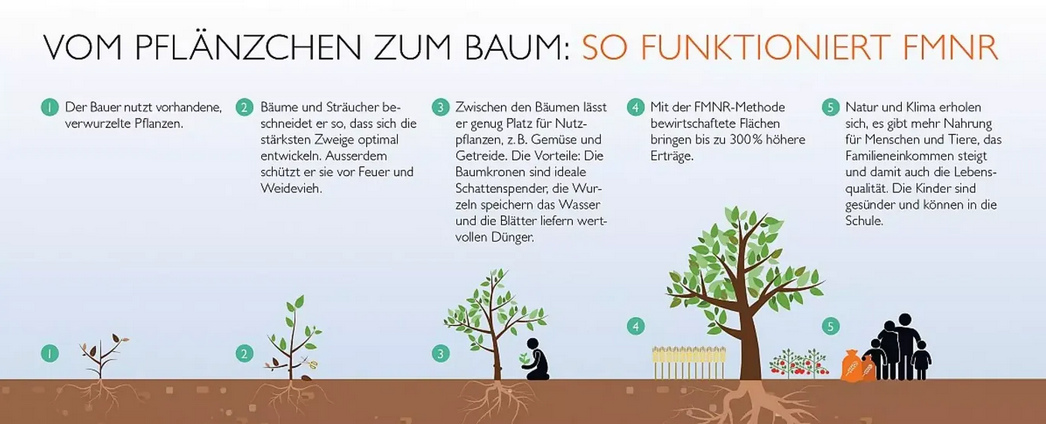
FMNR method is therefore about encouraging the existing plants with intact root systems to grow. The trees and shrubs are pruned in such a way that the strongest branches can develop optimally.
As a result, shrubs and stumps, which are usually worthless for agriculture, can grow back into healthy trees within a few years.
The FMNR method not only helps the environment but also small farmers, their families, and the people in the region. The green fields and reforested forests prevent erosion and damage from heat and wind. The soils retain moisture and restore fertility.
Sufficient space is also left between the individual trees to grow grains and vegetables. This, in turn, allows farmers to harvest greater yields – for themselves and their livestock. Families earn more and have enough to eat. They can send their children to school – thus breaking the cycle of poverty.
The international aid organization World Vision is already applying this simple yet groundbreaking technique in 25 countries and has thus made several million hectares of barren land fertile again worldwide. The forests that have emerged there, including in Niger, Ethiopia, and Kenya, are also significant for climate protection: wildlife returns, and birds spread the seeds of cultivated plants.
The FMNR method is thus a catalyst for sustainable development and enables a better future for the next generation – simply and at no cost.
Learn more about World Vision's work on climate change here (link German).
| Share: |
Facebook |
|
Twitter
X |
|
|
|
Sources
Photo sources
[1,2] https://www.nau.ch/blog/charity_partner/baume-pflanzen-gegen-den-klimawandel-ist-es-wirklich-so-einfach-66306360