


ENGL - ESP
<< >>
Landwirtschaft in Japan Meldungen 01
MeldungenAigamo-Landwirtschaft mit Tieren auf den Feldern
präsentiert von Michael Palomino
| Teilen: |
Facebook |
|
Twitter
X
|
|
|
|
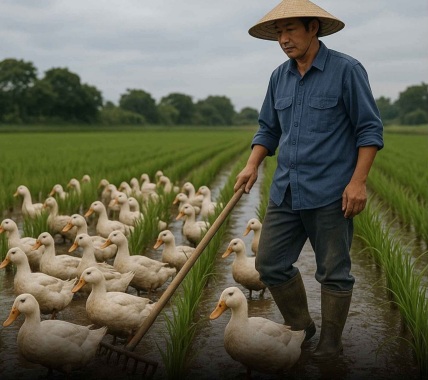
Japanische Aigamo-Landwirtschaft am 12.8.2025: Enten schwimmen in Reisfeldern
https://t.me/Impfschaden_Corona_Schweiz/118910
Japanische Aigamo-Landwirtschaft am 12.8.2025: Enten schwimmen in Reisfeldern [1]
In Japan greifen Landwirte auf eine alte umweltfreundliche Praxis zurück, indem sie anstelle von Pestiziden Entenarmeen in Reisfeldern einsetzen. Diese Enten bewegen sich frei zwischen den Pflanzen und fressen schädliche Insekten, Schnecken und Unkraut, die die Ernte bedrohen. Während sie durch die Reisfelder schwimmen und sich bewegen, düngen ihre Exkremente auf natürliche Weise den Boden und reichern ihn mit Nährstoffen an.
Diese als „Aigamo-Landwirtschaft” bekannte Methode macht den Einsatz chemischer Pestizide und Düngemittel überflüssig und ist somit sowohl für die Umwelt als auch für die Verbraucher gesünder. Durch ihre Bewegungen wirbeln die Enten außerdem das Wasser auf, wodurch Unkraut daran gehindert wird, Wurzeln zu schlagen, und der Sauerstoffgehalt für die Reispflanzen verbessert wird.
Durch die Verbindung von Tradition und Nachhaltigkeit beweisen japanische Landwirte, dass die Natur selbst die beste Schädlingsbekämpfung sein kann.
Gute Vibes abonnieren
👉 https://t.me/GuteNachrichtenNews
Die Mossad-Wikipedia hat einen Artikel über dazu:
Reis-Enten-Landwirtschaft (Aigamo)
Rice-duck farming
https://en.wikipedia.org/wiki/Rice-duck_farming (Stand 13.8.2025)


Japan: Enten in Reisfeldern (Aigamo-Landwirtschaft) [2] -- Enten im Reisfeld 03: Bali, Zeichnung von 1940ca. [3]
Indonesien, Insel Java, Magelang, Kajoran: Enten im Reisfeld 04, der Reisbauer treibt die Enten vor sich her [4]
Rice-duck farming is the polycultural practice of raising ducks and rice on the same land. It has existed in different forms for centuries in Asian countries including China, Indonesia, and the Philippines, sometimes also involving fish. The practice is beneficial as it yields harvests of both rice and ducks. The two are in addition synergistic, as the rice benefits from being weeded and fertilized by the ducks, and having pests removed, while the ducks benefit from the food available in the rice paddy fields, including weeds and small animals.
Systems
In 2010, Asia produced around 90% of the world's rice, and in 2012 some 80% of all duck meat. Asian farmers had a tradition of fattening ducks on rice paddies, though this was achieved in different ways. Integrated rice-duck farming uses hybrid ducks such as Aigamo that avoid eating the leaves of rice plants.[2][3] Such mutually-beneficial polycultural systems have been described as permacultures.[1]
Rice-duck systems[2][4]
Approach Location Time Effects Constraints Duck fattening Common across tropical and subtropical Asia After harvest Not a polyculture. Ducks eat spilt rice grain and earthworms in dry field Seasonal Rice-duck China, Malaysia, South Korea, Vietnam, etc. While rice is growing Ducks eat pests (e.g. brown planthoppers) in the crop; they stir water, limiting weeds, and manure the rice. Surface must be even; water depth must suit ducks; young ducks best as they don't nibble rice leaf tips.[5] Rice-fish-duck China Fishes bred on rice terraces Fattens ducks and fish, controls pests, manures the rice. Presence of fish limits use of pesticides. Rice-fish-duck-azolla Indonesia While rice is growing Fattens ducks and fish, controls pests, manures the rice.[1][6] Duck herder or fencing needed.
In 2001, rice-duck farming was introduced to Bangladesh, where the practice had been very limited. By 2004, it had been established in over 40 villages, either on small farms or on a "community basis" within a village.[7]Analysis
Advantages
The ducks eat weeds, preventing those plants from competing with the rice and limiting its growth.[4] This reduces the need for herbicides, saving money and the labour of spraying, and reducing environmental harms such as eutrophication of waterways. Duck manure fertilizes the paddy fields, reducing the need for artificial fertilizers, again saving money and labour.[1][2][8] Both soil nutrients and water parameters including nitrate, dissolved organic matter, dissolved oxygen, and suspended solids are higher because of duck manuring and dabbling in the soil, raising production and farm profits in comparison to rice farming without ducks (or fish).[9]
Disadvantages
The addition of ducks requires labour and either a duck herder or additional fencing on the farm. Depending on the system, it may require the field to be more carefully managed, such as being flooded to the exact depth needed for ducks to swim freely but still able to dabble on the bottom.[2]
See also
- Rice-fish system
- Takao Furuno, rice-duck farm pioneer in Japan
References
1. Bezemer, Marjolein (23 October 2022). "Mixed farming increases rice yield" (link). reNature Foundation. Archived (link) from the original on 11 October 2019. Retrieved 2 January 2024.
2. Suh, Jungho (2014). "Theory and reality of integrated rice–duck farming in Asian developing countries: A systematic review and SWOT analysis". Agricultural Systems. 125: 74–81. Bibcode:2014AgSys.125...74S. doi:10.1016/j.agsy.2013.11.003.
3. Furuno, Takao (2001). The power of duck (link): integrated rice and duck farming. Tagari Publications.
4. Sapcota, D.; Begum, Kashmiri (2022). "Integrated duck farming" (link). Duck Production and Management Strategies. Singapore: Springer Nature Singapore. pp. 247–264. doi:10.1007/978-981-16-6100-6_6. ISBN 978-981-16-6099-3. S2CID 246096613.
5. Furuno, Takao (link). Traditional and modern matters on rice cultivation associated with duck. 6th International Rice–Duck Conference. pp. 23–27.
6. Cagauan, A. G.; Branckaert, R. D.; Van Hove, C. (2000). "Integrating fish and azolla into rice-duck farming in Asia" (PDF link). Naga (ICLARM Quarterly). 23 (1): 4–10.
7. Khan, Malik Anwar; Ahmed, Gazi Jashim Uddin; Magor, Noel P.; Salahuddin, Ahmad (2005). "Integrated Rice-Duck: A new farming system for Bangladesh". In van Mele, Paul; Salahuddin, Ahmad; Magor, Noel P. (eds.). Innovations in Rural Extension (PDF link). Wallingford, Oxfordshire: CABI Publishing. pp. 143–155. ISBN 978-0-8519-9028-6.
8. Kang, Y. S.; Kim, J. I.; Park, J. H. (1995). "Influence of rice-duck farming system on yield and quality of rice". Korean Journal of Crop Science. 40 (4): 437–443.
9. Nayak, P. K.; Nayak, A. K.; Panda, B. B.; Lal, B.; Gautam, P.; et al. (2018). "Ecological mechanism and diversity in rice based integrated farming system" (link). Ecological Indicators. 91: 359–375. doi:10.1016/j.ecolind.2018.04.025. S2CID 90610992.
<< >>
| Teilen: |
Facebook |
|
Twitter
X
|
|
|
|


^