<< >>
The exercises of Mr. pioneer Roland Liebscher-Bracht (Liebscher-Bracht exercises)
supplemented with information from Dr. med. Ingo Froböse (Cologne, Germany) and from the channel "career as fitness trainer" (original German: "Karriere als Fitnesstrainer") - and: kitchen roll, prone position, swimming etc.
7c. Exercises to heal a true herniated disc
A herniated disc results from vertebrae that press against each other unevenly, so that one side of a disc is pushed out of the "socket" (7min.56sec.).
1. Liebscher-Bracht (near Frankfurt) - 2. Ingo Froböse (Cologne) - 3. Fitness trainer - 4. Kitchen roll, prone position, swimming etc.
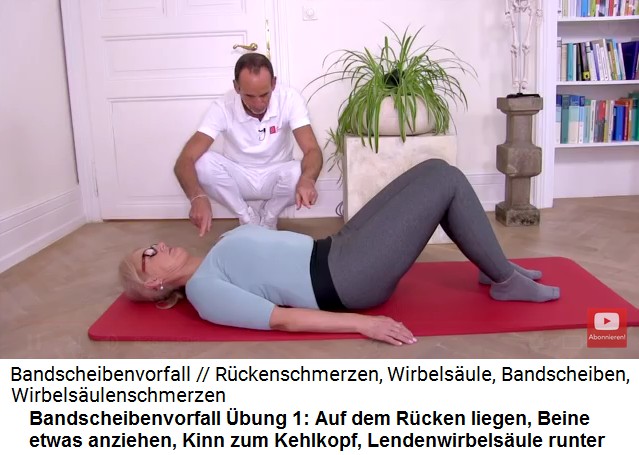
Herniated disc exercise 1: Position on the back with bent legs, chin "nodded" to the larynx, lumbar spine pushed down. [One can also put 2 normal books under your head]
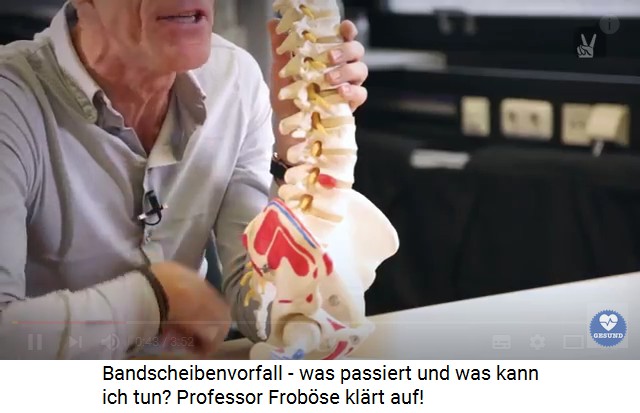
Dr. Ingo Froböse shows a model of a spine with a herniated disc (the red knob on one of the lower, large vertebrae)
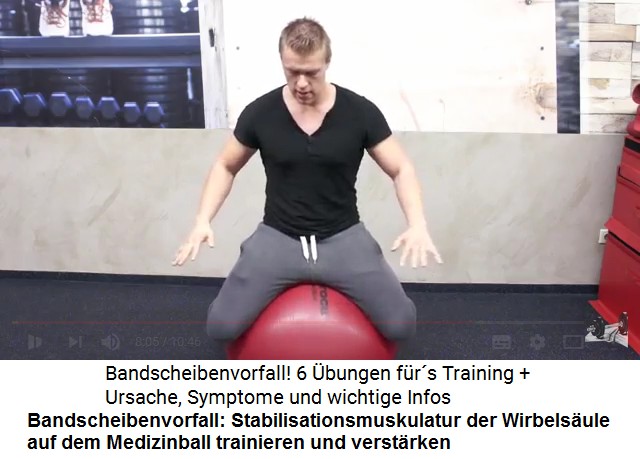
Balance exercise on the medicine ball, so the stabilizers of the spine are built
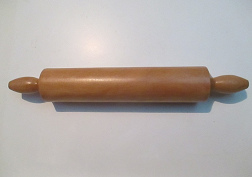
With the kitchen roll between the back and the mattress, the discs heal: Every 20 to 30 seconds "shift" it one vertebra up and let go the counter stretching of the spine around the roll [1]
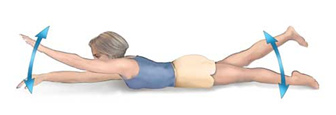
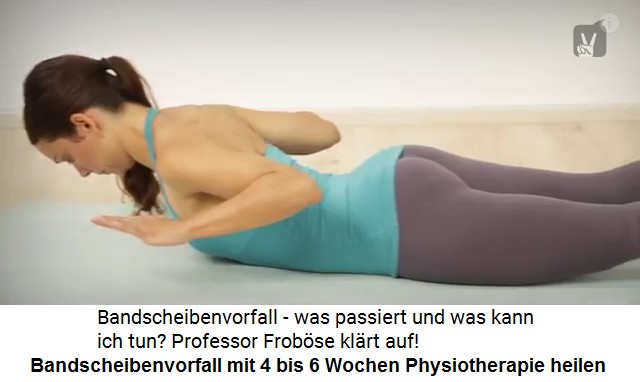
For spinal disc healing and spinal stabilizer stabilization, training and physiotherapy are required for 4 to 6 weeks, e.g. "swimming in the dry" on the stomach
Content
1. The Liebscher-Bracht exercises to cure a true herniated disc: The true herniated disc: The ruptured disc - herniated disc Massage 1: Small massage ball looking circling pain points on the upper edge of the pubis - herniated disc Massage 2a: massage pain point on the inner thigh left - - herniated disc Massage 2b: massage pain point on the inner thigh left - herniated disc Exercise 1: extension of the spine - Exercise 2a: prone position, legs up, the right heel should touch the hindquarters - Exercise 2b: prone position, legs up left heel should touch the rump - herniated disc Exercise 3: leaning on the elbows in the prone position and making a small hollow cross, let the pelvis sag -
2. Dr. Ingo Froböse, Cologne Sports University: Herniated discs in 4 to 6 weeks - exercises for the stabilization of the spine and the intervertebral discs -
3. Fitness trainer: The living conditions of the computer society against intervertebral discs - a herniated disc is a long process - nerve pain due to herniated disc - exercises to prevent a herniated disc or for rehabilitation after a herniated disc: back strengthening fitness center, stabilizers build on the medicine ball, eye exercises for stabilizers the cervical spine -
4. Michael Palomino: Exercise for the discs with the kitchen roll or a piece of broomstick - Compensation for the intervertebral discs and the spine: Lie on the stomach for a while - strengthen spinal muscles (stabilizers): swimming and doing exercises on the stomach
presented by Michael Palomino, massage, natural medicine (2017 / translation 2019)
Principle 1: Exercises with tensions and pressure provoke that stem cells come for reconstructing new cartilage.
from video: Fingerschmerzen / -arthrose | Die besten Übungen im Büro | Faszien-Rollmassage, Polyarthrose (7min.48sec.).
https://www.youtube.com/watch?v=ULnQk62PAHE (13min.47sec.)
Principle 2: For having an effect an exercise has to last at least 3 minutes and there has to be a "tearing" effect.
Principle 3: The massage ball should be soft, should give in a little bit hindering aches with bones. Wooden balls or similar hard things must not be taken for this.
from video: Fingerschmerzen / -arthrose | Die besten Übungen im Büro | Faszien-Rollmassage, Polyarthrose
https://www.youtube.com/watch?v=fCRmTIgiy8w (2min.0-22sec.)
Principle 4: Perform exercises slowly mm by mm: The fluid must be forced through tiny openings, and that's why all exercises have to be performed really slowly.
from video: Karpaltunnelsyndrom // Übungen zum Mitmachen // Video in Mitmachlänge
https://www.youtube.com/watch?v=F3CwPqCQMug&t=3s (8min.56sec.).
Principle 5: Pain levels: "8 means: It starts to hurt significantly (12min.19sec.). 9.9 means: It hurts even more (12min.24sec.), but not so much that calm breathing would be stopped, so the pain is not connected yet (12min.30sec.). Once docking with the pain, it's 10, then one has to reduce the tension a bit."
from video: Karpaltunnelsyndrom // Übungen zum Mitmachen // Video in Mitmachlänge
https://www.youtube.com/watch?v=F3CwPqCQMug&t=3s (12min.36sec.)
Slightly tormented smile: "A slightly tormented smile is always the right expression in the face" (9min.37sec.).
from video: Daumenschmerzen | 10-Minuten-Programm für den Daumen | Rhizarthrose, Daumensattelgelenk (11min.17sek.)
https://www.youtube.com/watch?v=WRqs_1Fdqsk (9min.37sec.).
The sponge: "Never roll back and forth (15min.17sec.)" That has no use, because we want to eliminate the liquid from the location pressing it like through a sponge."
from video: Rücken Übungen // Rückenschmerzen, Faszien Training, Übungen für den Rücken, Schmerzen Rücken (37min.23sek.)
https://www.youtube.com/watch?v=yTBKZ6N8hB8 (15min.25sec.)
Small massage ball: You can take a tennis ball, or a hard apple, any other ball of the appropriate size, from the nursery or the dog toy, anything of this size [which is not as hard as wood]. video: Rücken Übungen // Rückenschmerzen, Faszien Training, Übungen für den Rücken, Schmerzen Rücken (37min.23sek.)
https://www.youtube.com/watch?v=yTBKZ6N8hB8 (2min.17sec.).
Big massage ball: For the big massage ball you can also use a bigger ball, polystyrene balls for plants or flower arrangements, with the diameter of a male finger span.
from video: Rücken Übungen // Rückenschmerzen, Faszien Training, Übungen für den Rücken, Schmerzen Rücken (37min.23sek.)
https://www.youtube.com/watch?v=yTBKZ6N8hB8 (8min.37sec.).
Big massage roller: You can also take a sofa roll [or yoga roll]. [If you take a wooden kitchen roll, you must install a large notch in the middle so that the spinous processes do not touch the roll].
from video: Rücken Übungen // Rückenschmerzen, Faszien Training, Übungen für den Rücken, Schmerzen Rücken (37min.23sek.)
https://www.youtube.com/watch?v=yTBKZ6N8hB8 (13min.1sec.)

| Teilen / share: |
Facebook |
|
Twitter |
|
|
|
7c. Disc prolapse
1. The Liebscher-Bracht exercises to heal a real herniated disc
from: YouTube channel: Liebscher & Bracht | Die Schmerzspezialisten
Video: Bandscheibenvorfall // Rückenschmerzen, Wirbelsäule, Bandscheiben, Wirbelsäulenschmerzen (16min.8sek.)
https://www.youtube.com/watch?v=og2dLn-dF8kVideo: Bandscheibenvorfall // Rückenschmerzen, Wirbelsäule, Bandscheiben, Wirbelsäulenschmerzen (16min.8sek.)
Video: Bandscheibenvorfall // Rückenschmerzen, Wirbelsäule, Bandscheiben, Wirbelsäulenschmerzen (16min.8sek.)
https://www.youtube.com/watch?v=og2dLn-dF8k
The true herniated disc: The burst disc
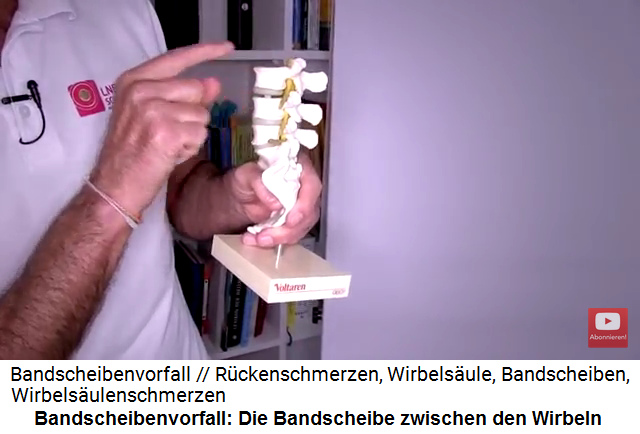
Intervertebral discs between vertebrae on the model: The intervertebral discs are located on the INNER SIDE of the spine
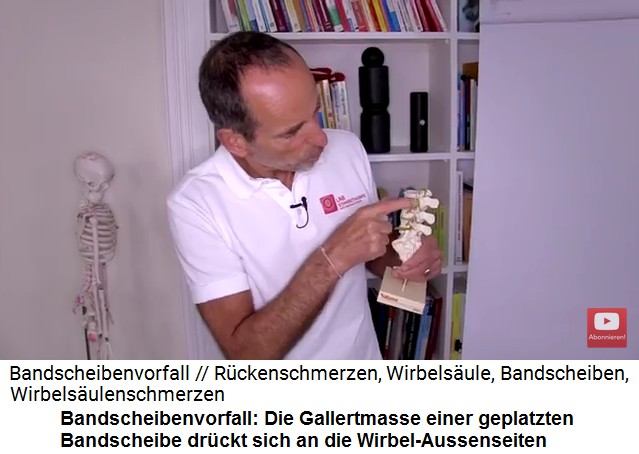
Herniated discs or disc protrusions (6sec.) Intervertebral discs are located between the vertebrae and have a gelatinous nucleus. If an intervertebral disc is constantly loaded with too much weight, it first bulges out like a tire at a weak point (1min.12sec.). In extreme cases, the intervertebral disc bursts (1min.18sec.). Part of the gelatinous mass then gets out of the "socket" and is pressing somewhere on the outside of the vortex (1min.27sec.).
The gelatinous mass of the burst intervertebral disc is pressing against the outer sides of the vertebrae
The theory [of "Pharma medicine"] states that these gelatinous pieces, which attach themselves to the outer sides of the vertebrae, pinch nerves and provoke pain (1min.32sec.).
But experience shows that pinched nerves are very, very rare and the absolute exceptions (1min.38sec.). The pain usually comes from unbalanced tension in the connective tissue (fascial tension). First is a cramp on the front of the vertebra, where the disc has burst. The muscles behind the vertebrae want to balance this and develop also a tension (1min.49sec.). There are exercises to balance the muscles and the it will be discovered that the pain has actually nothing to do with the ruptured disc (2min.24sec.). The gelatinous mass of the ruptured disc, which is located on the outer walls of the vertebrae, is usually reducing and is hardly harming or is not at all harming (2min.42sec.). The cases for surgery operations "are very, very rare" (2min.47sec.). The operations [in the "Pharma medicine"] are mostly because of the pain (2min.51sec.). There are then a lot of misunderstandings. Investigations came out with the results that many test persons who were "looking healthy" had herniated discs, buth they had NO pain (3min.8sec.). More and more orthopedists and surgeons now know about it (3min.19sec.).
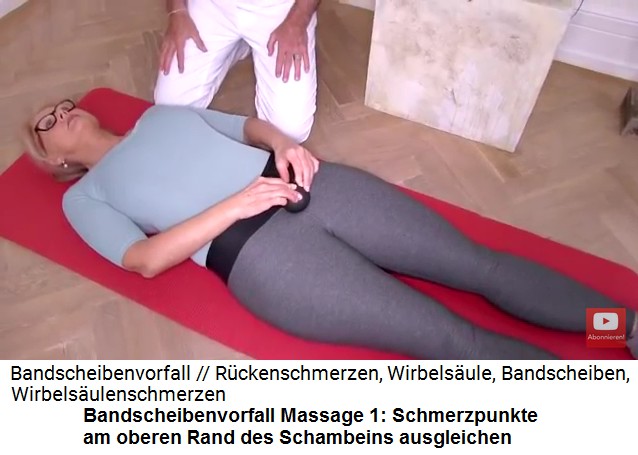
Herniated disc massage for relaxation 1: A small massage ball with circling movements is looking for hurting points on the upper edge of the pubis
[The massage begins at the counter side of the lumbar back region]: With the small massage ball, small circles are made at the upper edge of the pubis and pain points are searched (4min.21sec.). "As always, we avoid pressure pains that "go on toes", meaning that you can not breathe properly" (4min.37sec.). Locations with sharp little pains have to be omitted, don't massage them because there is anerve which does not want to be bothered or disturbed (4min.56sec.). At the upper edge of the pubis is fixed the "rectus abdominis muscle", which provides for "tension from the front" (5min.17sec.).
Herniated massge 1: The small massage ball is balancing pain points on the upper edge of the pubis
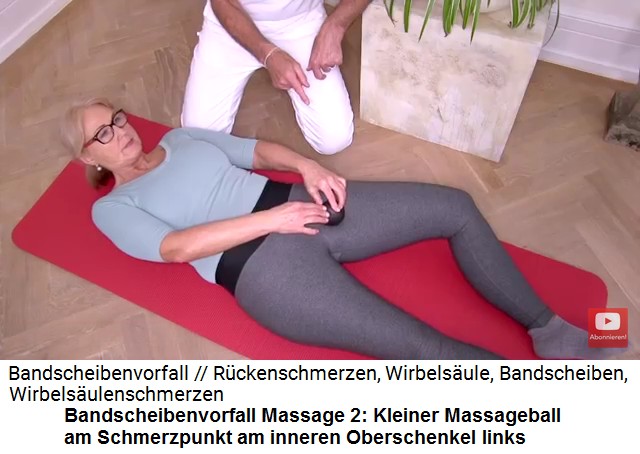
Herniated disc massage 2a: massage pain point on left thigh inner side
The small massage ball gives a massage to the pain point on the inner thigh, first circles on the left thigh (5min.52sec.), and then circles on the right thigh (7min.2sec.).
Herniated disc exercise 2a: The small massage ball massages the pain point on the inner side of the left thigh
With this exercise one can search also "deep" in the thigh for hurting points (7'8''). A herniated disc results from vertebrae, which press against each other in an unregular way, so that unilaterally one part of the disc is pressed out of the "socket" (7min.56sec.).
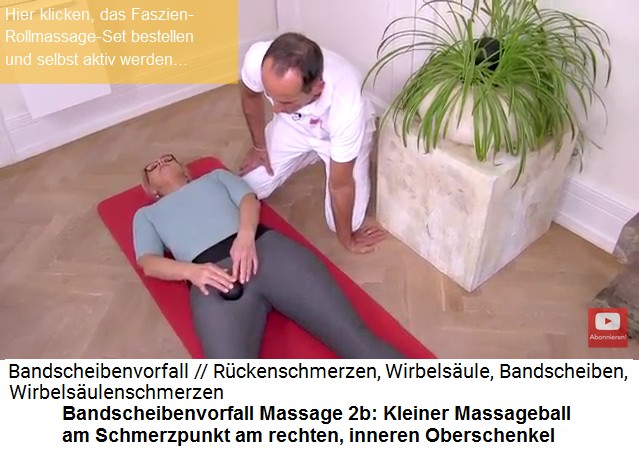
Herniated disc massage 2b: Hurting point at the inner side of the thigh gets it's massage
Herniated disc exercise 2b: The small massage ball is giving a massage to the pain point on the inner side of the right thigh
Herniated eisc exercise 1: Stretching of the spine
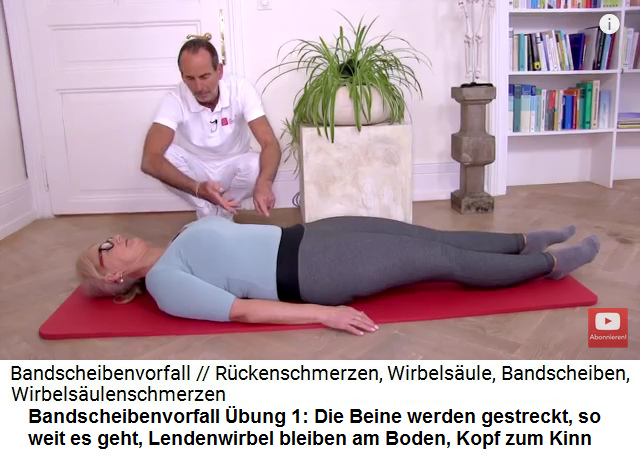
In the next exercise, the entire spine is straightened: lying on the back, the legs are slightly tightened, and the head is "tightened" somewhat towards the larynx to stretch the cervical spine (8min.8sec.). At the same time, the lumbar spine has to be lowered to the ground (8min.35sec.).
Herniated disc exercise 1: Position on the back with legs slightly bent, chin "nodded" to the larynx, lumbar spine pushed down
[One can also put 2 normal books under the head].
These two tensions on the neck and in the lumbar region are held while at the same time the knees are lowered more and more and the legs are stretched more and more. At the same time, the lumbar spine is kept down as far as possible (9min.8sec.).
Herniated disc exercise 1b: On the back, the lumbar vertebrae are pressed to the floor, the chin
drawn to the larynx, and now the legs are slowly lowered as far as possible
If the hip flexor is too short, you can not stretch your legs properly without the lumbar vertebrae moving to the lumbar position (9min.17sec.). Now the cervical spine, lumbar spine and knees are all pushed down simultaneously (9min.44sec.). This is a strength training for the spine (9min.57sec.). Then slowly go out of exercise and relax (10min.13sec.). In this exercise, all discs are relaxed, including the defective disc (10min.23sec.).
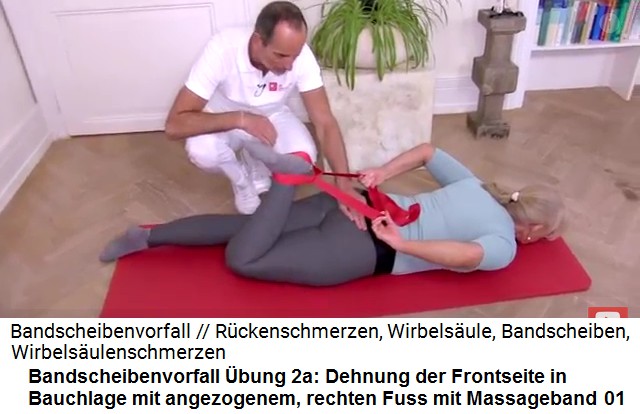
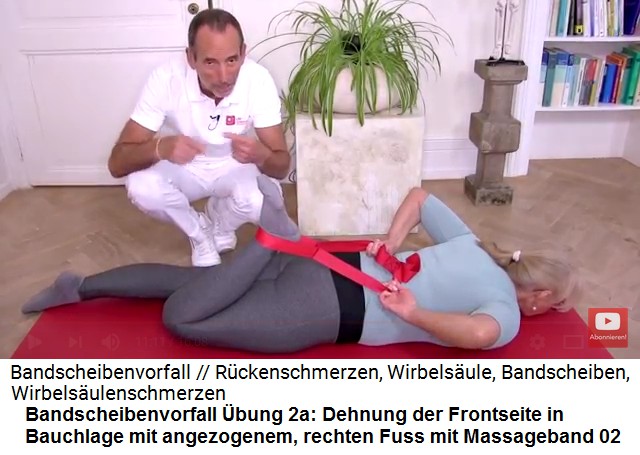
Exercise 2a: Prone position, legs bent up, the right heel should touch the buttock
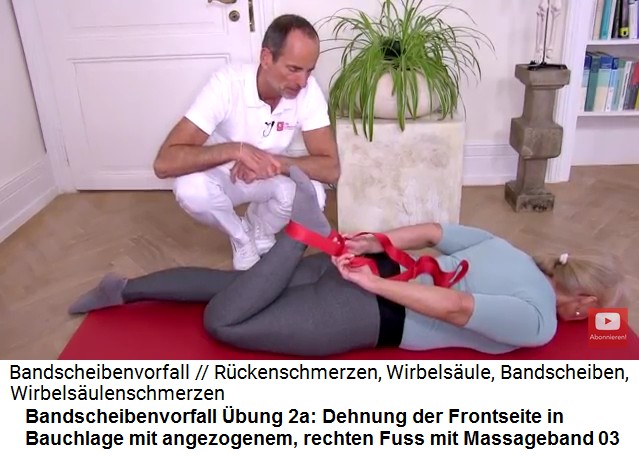
In the prone position, the heels should touch the buttock (10min.55sec.). At the same time, the pelvis remains on the ground. This exercise will cause a "stretching force" there, where it is thought that the disc is broken (11min.16sec.). This frees the affected disc from tension (11min.24sec.).
Herniated disc exercise 2a: Prone position, the right foot is torn with a massage band 01
Herniated disc exercise 2a: Prone position, the right foot is torn with a massage band 02
Herniated disc exercise 2a: Prone position, the right foot is torn with a massage band 03
Exercise 2b: Prone position, legs bent upwards, the left heel should touch the buttock
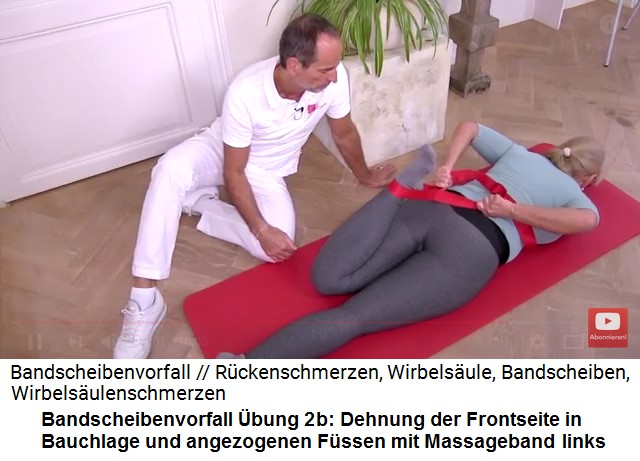
And then the exercise follows with the other foot (12min.22sec.).
Herniated disc exercise 2b: Prone position, the left foot is torn with a massage tape
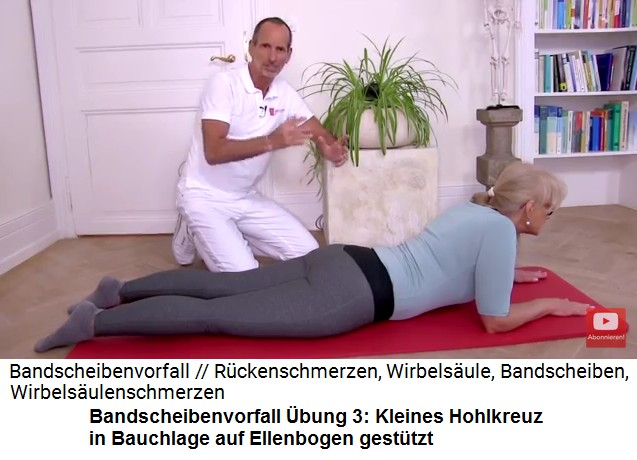
Herniated disc exercise 3: Lie in prone position on the elbows and make a small hollow back, letting the pelvis sag
Slowly get out of the exercise and then stem on the forearms, very slowly prop up as far as it goes until there comes the "stretching force", wait 30 seconds, then a little higher, wait another 30 seconds, then again a little higher, etc. So the tension is released and the disc is relieved (14min.43sec.).
Herniated disc exercise 3: Lie in prone position on the elbows and make a small hollow cross, let the pelvis sag
After a fresh case of herniated disc, one can do this exercise once a day, always with caution, and so the tensions will be loosened and eliminated that have caused the rotten disc (15min.3sec.). Each exercise takes 2 to 2 1/2 minutes (15min.28sec.).
========
2. Dr. Ingo Froböse, Sport University Cologne (Sporthochschule Köln): Disc heals in 4 to 6 weeks
from: YouTube channel HappyAndFitGesundheit
Video: Bandscheibenvorfall - was passiert und was kann ich tun? Professor Froböse klärt auf! (3min.52sek.)
https://www.youtube.com/watch?v=lm_RvizfP9E
Video: Bandscheibenvorfall - was passiert und was kann ich tun? Professor Froböse klärt auf! (3min.52sek.)
Video: Bandscheibenvorfall - was passiert und was kann ich tun? Professor Froböse klärt auf! (3min.52sek.)
https://www.youtube.com/watch?v=lm_RvizfP9E
Professor Ingo Froböse of the Sport University Cologne
The disc is often associated with back pain, although there is no case of herniated disc (20sec.). A bulging disc or leaked tissue is a herniated disc. The disc herniations often occur in the area of the lumbar spine, where the load is greatest, but where the vertebrae and intervertebral discs are also the largest (1min.14sec.).
Dr. Ingo Froböse shows a model of a spine with a herniated disc (the red knob on one of the lower, large vertebrae)
But now the data are like this: only 2 to 3% of back pain is caused by herniated discs (1min.25sec.). Often disc herniations are not noticed (1min.35sec.). Only when a nerve is pressed, pain occurs (1min.40sec.). Spinal discs heal by themselves in 4 to 6 weeks (2min.7sec.). Most back pain disappears completely after 4 to 6 weeks (2min.13sec.). But when nerves are affected, a feeling of numbness is produced, eventually with paralysis, then go to the doctor for emergency (2min.37sec.). Also incontinence is possible, then go to the doctor (2min.39sec.). Without much pain, paralysis or incontinence, a lot of training and physiotherapy is needed to regenerate the disc WITHOUT surgery (2min.56sec.).
For healing of spinal disc and for stabilizing of the stabilizer of the spine, training and physiotherapy is needed during 4 to 6 weeks, e.g. "swimming in the dry" on the stomach
========
3. Fitness trainer: exercises for the stabilization of the spine and the intervertebral discs
from: YouTube channel Karriere als Fitnesstrainer
Video: Bandscheibenvorfall! 6 Übungen für´s Training + Ursache, Symptome und wichtige Infos (10min.46sek.)
https://www.youtube.com/watch?v=g7EoDtt05Ks
Video: Bandscheibenvorfall! 6 Übungen für´s Training + Ursache, Symptome und wichtige Infos (10min.46sek.)
Video: Bandscheibenvorfall! 6 Übungen für´s Training + Ursache, Symptome und wichtige Infos (10min.46sek.)
https://www.youtube.com/watch?v=g7EoDtt05Ks
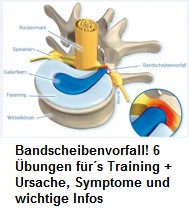
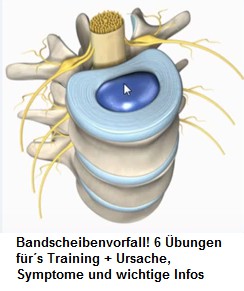
An intervertebral disc consists of a fibrous ring (annulus fibrosus) and of a gelatinous core (nucleus pulposus) (1min.7sec.).
Intervertebral disc with fiber ring and gelatinous core, scheme
An intervertebral disc is firm and stable and can withstand high pressure, per cm2 300kg vertical pressure (1min.15sec.). With enough muscle building, there are enough supportive muscles around the spine's vertebrae, and this relieves the intervertebral discs additionally (1min.39sec). The spinal disc feeds like a sponge during the movements. The intervertebral disc is sucking the nutrient-rich water (1min.54sec.). Only with movement the intervertebral discs are fed well (2min.4sec.).
The living conditions of the computer society against intervertebral discs
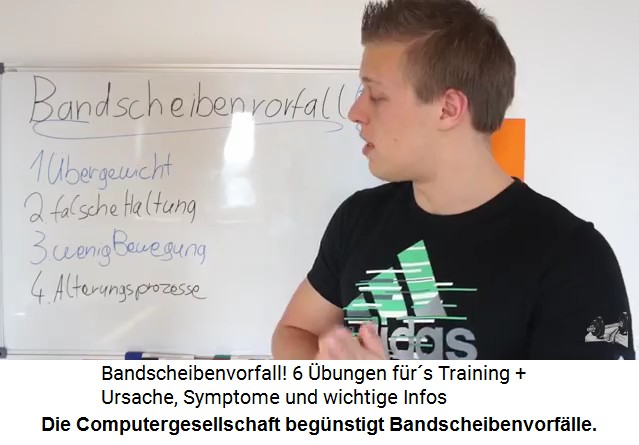
But the computer society has 1) often overweight - 2) wrong attitudes - 3) little movement - 4) and people are getting very old today. The older you get, the more muscle is reduced, the less the spine is supported by muscles (2min.58sec.).
The computer society behaves against discs with obesity, wrong attitude, little movement, old age
The fiber ring breaks down slowly, the gelatinous core loses more and more of liquid, because people hardly move (3min.24sec.). The elasticity decreases. As a result, the fiber ring can tear and a part of the gelatinous core can escape to the outside (3min.39sec.). The nucleus then presses on the spinal nerve, which can cause great pain (3min.46sec.).
Herniated disc: The fibrous ring is broken, the gelatinous core comes outside and is pressing on a nerve - scheme
A herniated disc is a long process
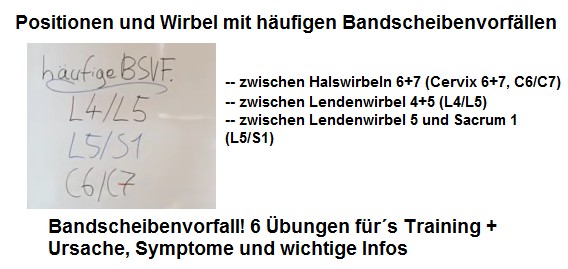
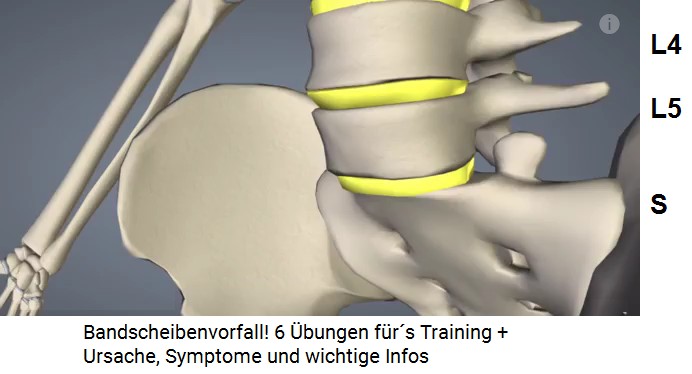
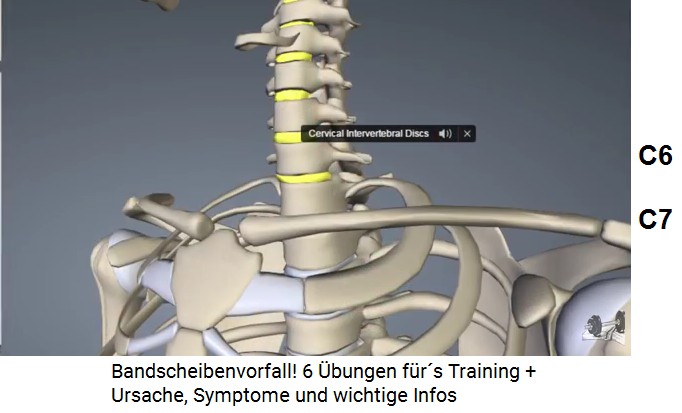
A herniated disc is caused by a long-lasting, unfavorable pressure change (4min.5sec.). At some point, the fiber ring is broken and the gelatinous nucleus comes out (4min.16sec.). It then only needs an extreme movement and load and then the fiber ring will break, for example. when someone brings a box of beer to the house (4min.40sec.). The most common disc herniations occur between lumbar spines L4 / L5 and L5 / S1 (sacrum), also at the cervical spine between C6 / C7 (5min.1sec.).
The positions and vertebrae with the most common cases of herniated discs
Lumbar vertebrae L4 and L5 of sacrum, scheme
The cervical vertebrae C6 and C7, scheme
Nerve pain by a case of herniated disc
When on the cervical spine a case of herniated disc is happening, the gelatinous core is pressing on the nerve at the cervical spine, and this nerve can radiate into the arms (5min.24sec.).
This can also cause a feeling of paralysis (5min.30sec.). When there is a case of disc herniation in the lumbar vertebrae region and the gelatinous nucleus presses on the nerve there, the pain can radiate to the legs, possibly with a feeling of inertia and a feeling of paralysis (5min.37sec.). When the gelatinous core during it's exit is not hitting a nerve, then the herniated disc causes NO pain (5min.53sec.).
Exercises to prevent a herniated disc or to rehabilitate after a herniated disc: back strengthening fitness center, build up stabilizers on the medicine ball, eye exercises for stabilizers on the cervical spine
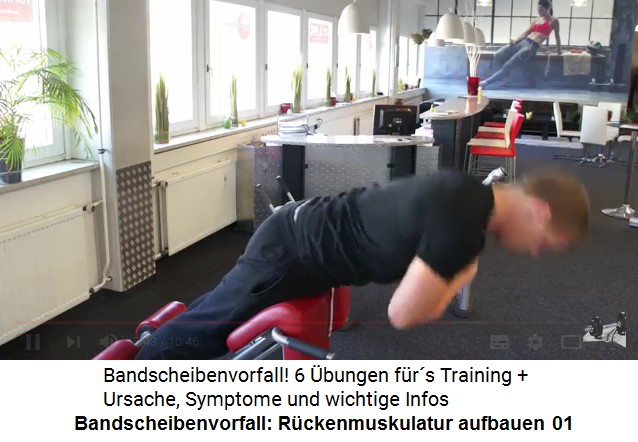
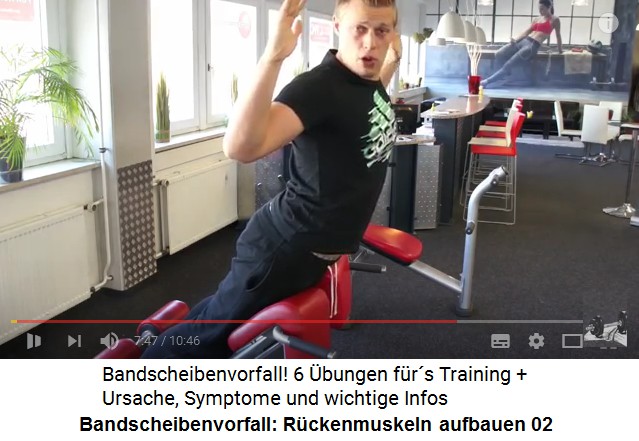
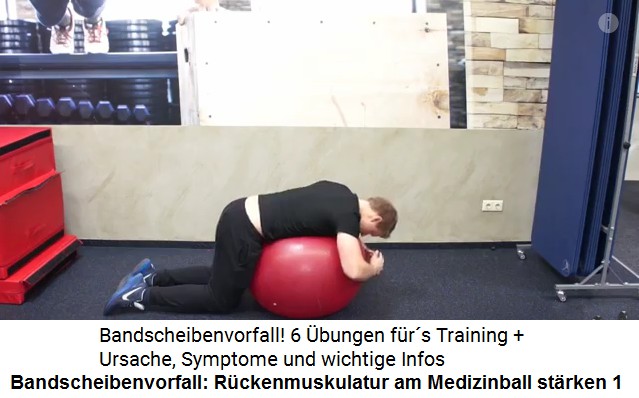
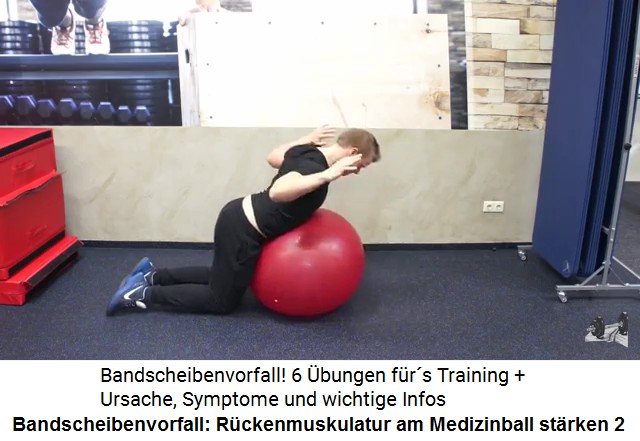
The stabilizers around the spine have to be rebuilt with gentle exercises, and then people go to the gym (6min.33sec.). It then continues with stabilization exercises, smaller movements, smaller weights, and then the exercises will be increased: Longer exercise, more weight, greater range of motion (6min.49sec.). In addition, a full-body training is announced to strengthen the muscles around the affected vertebrae (6min.58sec.): When there is a case of herniated disc in the lumbar region one has to strengthen the back, strengthen the hip, strengthen the trunk, and when there is a case of herniated disk at the neck one has to strengthen the shoulders (7min. 11sek.).
Gym: Build back muscles 01
Gym: Build back muscles 02
Balance exercise on the medicine ball, so the stabilizers of the spine are built
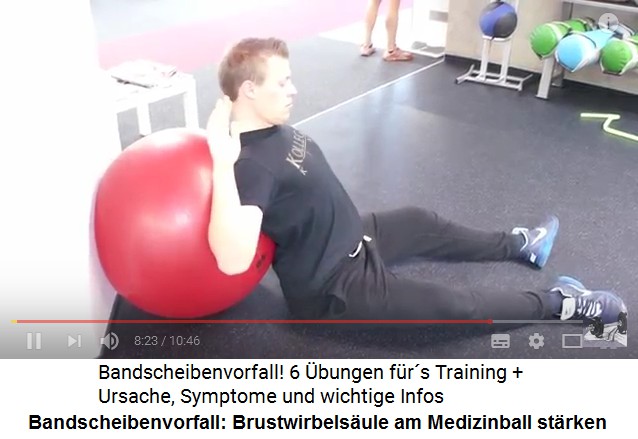
The thoracic spine can be strengthened with the medicine ball
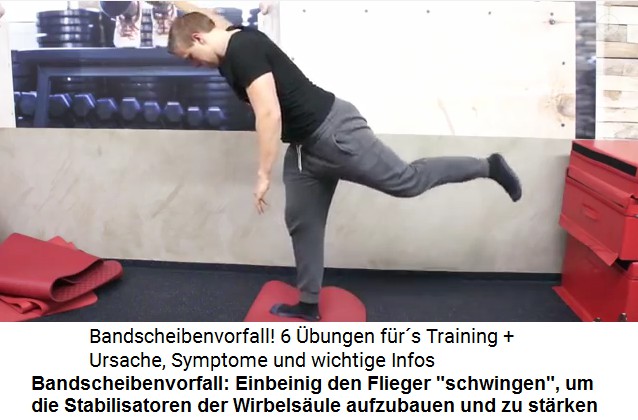
With "flyer wings" are built new stabilizers of the spine
With a medicine ball the back muscles are built up
With a medicine ball the back muscles are built up 02
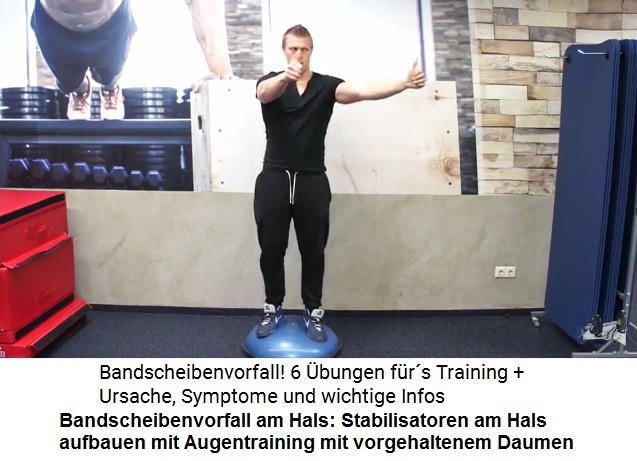
The stabilizers of the cervical spine are strengthened with eye training, whereby the eye
is looking after a held thumb, without turning the head
========
Michael Palomino, portrait
4. Michael Palomino: exercises for the intervertebral discs
Exercise for the discs with the kitchen roll or a piece of broomstick
You lie with your back on a mattress and put a kitchen roll between the coccyx and the mattress. Every 20 to 30 seconds you shift up the kitchen roll by one vertebra up to the thoracic spine. The contra-stretching around the kitchen roll allows the intervertebral discs to balance and relax so that the intervertebral discs will normalize within a few days. This also applies to the gluteal muscles and the sciatic nerve. On the floor or on the yoga mat this exercise is possible also with a piece of broomstick.
With the kitchen roll between the back and the mattress, the discs will heal: Shift up by one vertebra every 20 to 30 seconds allowing the contra-stretching movement [1]. This exercise once a week for prevention is excellent for the intervertebral discs. For curing purposes make it daily 3 to 5 times.
Sie wollen Bandscheibenprobleme vermeiden, einen Buckel vermeiden. Als Ausgleich, wenn Leute im Sitzen arbeiten müssen, können die Betroffenen täglich eine Weile (so 15 Minuten bis eine halbe Stunde täglich)
-- ein paar Minuten auf dem Bauch liegen
-- auf dem Bauch schlafen,
-- auf dem Bauch ein Buch lesen etc.
Compensation for the intervertebral discs and the spine: Lie on your stomach for a while
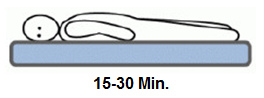
You want to avoid disc problems, avoid a hump. As compensation, when people have to work always in a sitting position, the affected people can take a while daily (so 15 minutes to half an hour daily)
-- lying on the stomach for a few minutes
-- sleep on the stomach,
-- read a book on the stomach or watch TV etc. in a prone position on the ellbows - THIS IS THE BEST POSITION FOR BALANCING SPINAL DISCS , etc.


Balancing and healing of intervertebral discs: 15 to 30 minutes on the stomach reading a book - talking on the stomach or on the stomach watching TV [3] or lying on the stomach for a while or sleep [4]
The same counts for the public swimming pool: being in a prone position on the stomach set up on the elbows on the lawn has a high care effect for the vertebrae and intervertebral discs. However, being set up on the elbows should not be done too long, otherwise the shoulder joints will be heavily strained. And the hollow cross should not be exaggerated, otherwise the diseased hollow back (lordosis) comes.
Strengthening spinal musculature (stabilizers): swimming and doing abdominal exercises - dancing and symphony
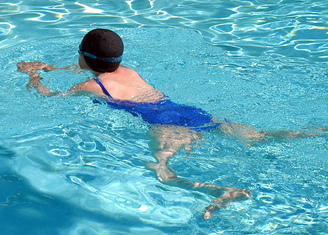
Calm swimming is the best physiotherapy for the spine. People who live by a lake have this option:
Swimming well is the best physiotherapy and strengthening for the spinal musculature, for people who live by a lake or swimming pool [5]
New physiotherapy integrates abdominal exercises to strengthen the spine musculature:
Strengthening stabilizers of the spine: doing exercises on the stomach [6]
For the healing of spinal discs and strengthening of the spinal stabilizers, training and physiotherapy are required for 4 to 6 weeks, e.g. "swimming in the dry" on the stomach
And those who just learn a little bit African dance moving the spine in an easy way will NEVER have any spinal disc problems, and also a symphony in the bed is a strengthening of the back and of the spinal muscles. Respectively a symphony (love which does not only last 3 minutes) will be "really good" when hips can be moved in an easy way. So go on! For example with Kamba dance from Kenya - nature has given it all not to be cramped:
Video: BEST KAMBA MUSIC KENYA (25min.31sek.)
Video: BEST KAMBA MUSIC KENYA (25min.31sek.)
https://www.youtube.com/watch?v=76jLfU60cOE
Learning African dancing and Latino dancing or belly dancing is the best prevention against herniated discs and sciatic pains because the persons learns to keep their muscles relaxed and are "dancing" through life.