Coneflower flowers come from the "USA" and can
be found across Oregon to Georgia as well as from Kansas to
Texas down in the whole prairie.
Immune booster against
incipient infections -- rapidly increases white blood
cells [the defense cells] -- prophylactic against colds --
inflammatory diseases, flu, tonsillitis, respiratory tract
infection, hoarseness -- mitigates and shortens flu --
skin diseases, vascular diseases, cancer -- echinacea is
in lozenges for respiratory infections -- echinacea tea
for severe colds -- eye drops -- ointment for wound
healing or colds [in throat and chest] -- echinacea
tincture (false coneflower) diluted as mouthwash or wound
disinfection -- coneflower+elderberry+vinegar strengthen
each other optimally -- also in animals -- not in
pregnancy, breastfeeding, allergies (nausea, rash) -- not
in autoimmune diseases or systemic diseases such as TB,
connective tissue inflammation or MS
Echinacea (coneflower) on a meadow in different colors [1]
News
presented by Michael Palomino (2022 - translation with
Translator.eu and with Deepl 2023)
from: Facebook: On the track of truth (orig. German: Der
Wahrheit auf der Spur); May 2, 2013;
https://www.facebook.com/derwahrheitauf.derspur (2020 no
access any more)
In 2020 on Facebook:
https://www.facebook.com/groups/1720841941507974/ (On the
track of truth (orig. German: Der Wahrheit auf der Spur)
On Dec 16, 2022 can be found on Facebook here: Koko Simon:
https://www.facebook.com/photo/?fbid=638246596557109&set=a.137043113344129
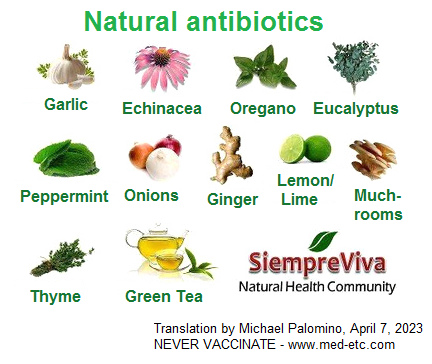
Natural antibiotics: garlic, echinacea, oregano, eucalyptus,
peppermint, onions, ginger, lemons / limes, mushrooms, thyme,
green tea - and missing in the photo: the honey and
horseradish [2]
Echinacea (coneflower): the antibiotic
Echinacea (fake coneflower)
Antibiotic Echinacea (false coneflower) and the extract
[3]
Echinacea (coneflower)
The coneflower is a genus that belongs to the Echinacea
family. Echinacea as a remedy works against bacteria and
viruses by activating the blood cells of the immune system,
which absorb the infectious agent in the human body and
produce antibodies. [web01]
It contributes to the stimulation and strengthening of the
immune system, that is, the natural ability of humans to
defend themselves against infectious diseases. It helps in
the prevention and treatment of acute and chronic
inflammatory diseases, influenza, tonsillitis, respiratory
infections, skin and vascular diseases, and also an
anti-cancer effect is mentioned in investigations. [web01]
The coneflowers for healing purposes
For medicinal purposes of natural medicine, the following
three echinacea flowers are of utmost importance: Echinacea
purpurea, pallida and angustifolia [web02].
Depending on the disease, fake echinacea can be taken as
drops, globules, tablets, tea or as eye drops or ointments
[web01]. Echinacea preparations are available as echinacea
tea, echinacea pressed juice, echinacea extract as capsules,
tablets, globules, coated tablets, ointments, tinctures with
drops, there is no spice aroma [web03].
Healing effects of Echinacea in
humans
-- Echinacea is a general immune booster against
infections, with an increase in the body's defenses
[web07]
-- provokes an effect rapidly increasing the number of
white blood cells [the immune cells] [web07]
-- taken prophylactically it has an effect against
colds in autumn [web07]
-- inflammatory diseases, influenza, tonsillitis,
respiratory tract infection [web01]
-- treatments should be started at the onset of the
first symptoms of an infection, in the middle of an
already developed flu, echinacea "can no longer do
much" [web07]
-- mitigates and shortens the flu [web07]
-- skin diseases, vascular diseases, cancer [web01]
-- Echinacea is usually combined with other natural
remedies in lozenges against respiratory infections
[web07]
-- Echinacea tea for severe colds [web07]
-- Echinacea as eye drops should always be discussed
with the ophthalmologist [web07]
-- Echinacea as an ointment for wound healing or
against colds [in the neck and chest area] [web07]
Echinacea tincture (false coneflower) can be diluted
in water and
-- can be used as a mouthwash (pulling it in the mouth
or gargle it), heals infections and wounds [web03]
-- can be used as a cleansing solution for skin
infections or wounds [like Merfen, but natural]
[web03]
Combinations:
-- Coneflower + elderberry + vinegar strengthen each
other optimally [web03]
Healing effects of echinacea
in animals
Echinacea healing effects:
https://www.natur-kompendium.com/echinacea/
-- is used successfully [web07]
-- is a general booster for the immune system [web07]
-- rapidly increases the number of white blood cells [the
immune cells], which happens mainly in mammals such as dogs,
cats and horses [web07]
-- dose in animals: Rule of thumb: 0.3 grams per 10kg body
weight [web07]
An overdose with echinacea is hardly possible if there is no
allergy to echinacea, so a dose of 0.5 to 1 gram is not
harmful [web07].
Negative indications
-- don't use it during pregnancy
-- not while breastfeeding
-- dangerous in case of allergies to composite plants
-- don't use it when there are autoimmune diseases or
systemic diseases such as TB, connective tissue inflammation
or MS [web03]
-- when there is an allergy to echinacea, this will cause
nausea, rashes or other reactions [web07].
Summary
Echinacea (coneflower)
-- the coneflower (Echinacea) is native to the "USA", from
the Midwest [web01] or let's say, from eastern and central
North "America" [web02]
-- Echinacea flowers are found in western Canada, in the
northwestern "USA", then the whole central strip of the
"USA" up to Texas as well as in Georgia in the east of the
"USA" [web02]
-- all in all, there is a total of 9 Echinacea species, 3
of which are medically important [web03]
Echinacea (coneflower) on a meadow in different colors [1]
The plant: root, leaves, flowers, seeds
-- among the natives in North "America" the echinacea
flowers are a medicinal plant since ancient times [web01],
they grow there on meadows and in the high mountains, the
root is a deep taproot [against drought] [web03]
-- the green leaves are up to 20cm long, oval to oblong
serrated and hairy [web03]
-- flowering season is May to August with 300 tubular
flowers and arranged like hedgehog spines [web03]
-- the coneflower forms special nut fruits (achene fruits)
that form greenish to reddish-brown flying umbrellas
(pappus) that are dispersed by the wind [web03]
The distribution in Europe
-- the Jesus fantasy colonialists brought the flower to
Europe as an ornamental plant [web01], and since the
medicinal effects are known, coneflowers are also
cultivated in gardens [web03]
-- now pharmaceutical antibiotics are becoming more and
more harmful, so the research is researching the
antibiotic properties of coneflowers more and more [web01]
-- the coneflowers are popularly called "hedgehog heads",
the Latin name Echinacea is derived from the ancient Greek
word "echinos" for sea urchin, because the spreading
leaves are so pointed [web02], the vernacular simply says
"hedgehog head" [web03].
-- coneflowers grow 50cm to 1m tall [web03] or even
up to 1.4m tall [web02] and are also a protection wall as
needed [web07]
-- botanist Conrad Moench gave the flower the name
"Echinacea" -- another botanist Neck gave the flower the
name "Brauneria" [web02]
The false coneflower (Echinacea) in the garden in
Europe - basic knowledge
Video on YouTube: Echinacea Plant | What You Should Know
(9'34''):
(orig. German: Sonnenhut Pflanze | Was Sie wissen sollten
(9'34'')
https://www.youtube.com/watch?v=sSjwgZstAf0 [web04]
The false coneflower (Echinacea) in the garden in Europe -
basic knowledge [8] - The false coneflower (Echinacea) is
very popular with bees, is a bee plant [9]
Video
protocol:
-- false coneflower (Echinacea - also called hedgehog's head
because of its hard flower center) is a perennial, non-toxic
medicinal plant that keeps coming back, the flower does not
need much water, can survive short droughts (1'40'') --
closely related flower: Rudbeckia, but it does not tolerate
drought (2'9'') -- coneflower is very popular with bees
(2'30'') -- echinacea is available in tablet form, is good
for the immune system (2'48'') -- false coneflower needs a
lot of sun, sunny location is a condition, the flower is
called "sun" coneflower (3'7'') -- clay soil does not work,
because in case of waterlogging the coneflower dies already
in the first winter (3'23'') -- normal soil is enough, with
compost even better (3'35'') -- in autumn the coneflower
remains uncut, the coneflower overwinters uncut together
with the grasses, this gives a nice winter picture (3'51'')
-- coneflower plants are cut to 2cm only in spring in March
(3'59'') -- then the coneflower sprouts again, you can help
again with compost, the flower will now be bigger than in
the first year, you can also help with perennial fertilizer
(4'38'') -- coneflower (Echinacea) responds to perennial
fertilizer, is a perennial (4'51'') -- coneflower is very
popular with slugs, so you should have measures against
slugs if you have coneflowers in the garden (5'16'') --
after 4 to 5 years, coneflowers don't bloom as much, they
develop a 60 to 70cm diameter environment (5'32'') -- the
perennial goes into regression despite sun and compost, then
you can dig up the perennial, divide and replant and the
cycle starts all over again (5'58'') -- in partial shade,
coneflowers often get powdery mildew, so partial shade is
unfavorable (6'9'') -- coneflowers grow well in large pots
on the balcony (6'31'') -- coneflowers bloom from June to
October, some varieties from July to September (6'40'') --
coneflowers on the balcony are NOT cut back in the fall, but
is cut only after winter in March (7'1'') -- coneflowers are
a paradise for bees (7'17'') -- old, withered flowers are
cut off just above the leaves, making room for new young
flowers coming from below (8'13'') -- brown leaves are
plucked out, always pluck them from top to bottom (8'44'')
[web04]
Common and false coneflower (echinacea) in the garden in
Europe
Video on YouTube: North German TV station NDR: My afternoon
- Continuous bloomers for late summer Echinaceas (9'57'')
(orig. German: NDR Mein Nachmittag – Dauerblüher für den
Spätsommer Sonnenhüte)
https://www.youtube.com/watch?v=h83IVeic_NI [web06]
Video on YouTube: North German TV station NDR: My
afternoon - Continuous bloomers for late summer Echinaceas
(9'57'')
(orig. German: NDR Mein Nachmittag – Dauerblüher für den
Spätsommer Sonnenhüte) [7]
Video on YouTube: NDR Mein Nachmittag - perennial
bloomers for late summer coneflowers [7].
Video transcript:
-- the true coneflower has a soft flower, is without
healing properties, the false coneflower is prickly like a
hedgehog, was then called Echinacea by botanists, Greek
Echinos = sea urchin (55'') -- in pharmacies today you can
buy Echinacea preparations of the false coneflower, a
remedy of the natives of the "USA" (1'5'') -- false
coneflower is combined best with grasses, this brings
"lightness and color to the garden", and the winter
picture then goes with brown seed pods, the grasses have a
bronze color, with hoarfrost and frost together it makes a
nice "winter picture" (2'8'') -- false coneflower comes
from the prairies of the "USA", so in summer lots of sun
and it survives winters with down to minus 40 degrees
(2'35''), grows well in well-drained soil, locations with
with clay soil need to mix sand in it (3'9'') -- bad
conditions are clay soil, heavy soil, too much fertilizer
(3'31'') -- [now follow other topics with pests on roses,
etc. ]
-- common coneflower has, for example. the variety "Gold
Storm" (orig. German: "Goldssturm") in yellow, a red
variety "Rubi glob", and the "Automn Sun" (German:
"Herbstsonne") grows up to 180cm high (6'37'') -- blue
flowers come from summer sage or dwarf verbena (7'17'') --
you can also plant inconspicuous plants like stonecrop
with light blue flowers, which smells like peppermint
(7'43'') -- true and false coneflowers have the same
living conditions (8'11'') -- and more and more colors are
being cultivated, a "red coneflower" nowadays can also
have another color (8'28'') -- you can make real color
shows in the garden with the coneflowers and companion
plants (8'45'') -- in winter the coneflowers are left
standing and cut only in spring (9'16'') -- loose soil,
not too much fertilizer, let the fall foliage during the
winter (9'38'') -- the cut will be only in spring after
the late frost (9'46'') [web06]
Make coneflower remedy
Make coneflower tea
-- put fresh leaves+flowers in hot water infusing for 10
minutes [web03]
-- when leaves+flowers ware dried, then they have only a
part of the valuable active ingredients left [web03]
Make juice of echinacea (plant juice)
-- use a juicer for producing a pressed juice of echinacea
[the parts are not mentioned] [web03]
-- "It is recommended to take 5 milliliters of pressed
juice 2 times a day before meals. Children can also drink
the echinacea juice to strengthen their immune system."
[web03]
Sonnenhut-Tinktur herstellen: aus Wurzeln oder Kraut [mit
Blüten?]
-- Wurzeln oder Kraut des Sonnenhuts werden in ein Glas mit
Schraubverschluss gesteckt, dann mit Doppelkorn oder
Weingeist gefüllt, alle Pflanzenteile müssen bedeckt sein
[web03]
-- das verschlossene Glas wird 2-6 Wochen lang ziehen
gelassen [web03]
-- dann ist die Tinktur fertig, gesiebt in eine dunkle
Flasche umfüllen [web03].
Make echinacea tincture: from roots or herb [with
flowers?]
-- roots or herb of echinacea are put in a jar with screw
cap, then filled with double grain or spirit of wine, all
parts of the plant must be covered [web03]
-- the sealed jar is left to infuse for 2-6 weeks [web03]
-- then the tincture is ready, transfer strained into a dark
bottle [web03].
The echinacea tincture should be taken maximum 3 times a day
with 10 to 50 drops and diluted with water according to
taste [web03].
Other websites indicate that in the root is the healing
effect. Quote (translation): "The effective part of
Echinacea is the root." [web07]
Make echinacea tincture: Video
Video: Growing medicinal plants in
the garden. Harvesting, extraction of echinacea extract
(17'22'') (Heilpflanzen im Garten anbauen. Ernte, Gewinnung von
Echinacea Auszug (17'22'')
Video: Heilpflanzen im Garten anbauen.
Ernte, Gewinnung von Echinacea Auszug
(17'22'')
https://www.youtube.com/watch?v=aCYbj8fClbo -
YouTube channel: Wolfs
Welt - uploaded on July 13, 2019
Video: Growing medicinal plants in the garden.
Harvesting, extraction of echinacea extract (17'22'').
(orig. German: Video:
Heilpflanzen im Garten anbauen. Ernte, Gewinnung von
Echinacea Auszug (17'22'')
https://www.youtube.com/watch?v=aCYbj8fClbo -
YouTube channel: Wolfs
Welt - uploaded on July 13, 2019.
-- Echinacea acts against colds, hoarseness, sore throat,
grows like a weed (1'25'') -- take an applesauce jar, take
high-proof alcohol, on the Internet there are indications
going around indicating alcohol of at least 50%, vodka 40%
is also working, the medicine then lasts 1 year (2'17'')
-- stems, flowers and leaves, always soft parts, nothing
woody (2'35'') -- and always bees are at the coneflower
(2'40'') -- the petals are put on a pile, the leaves on a
pile, stems are separated from the woody parts and cut
open (4'0'') -- the cut open stems are whitish and hollow
and that is put into the jar (4'5'') -- the flowers are
cut in half or quarters and put into the jar (4'10'') --
the leaves are cut small and put into the jar (4'18'') --
always check the flowers first, you may have to sort out
parts of them because of contamination (5'11'') -- so it
goes with approx. 10 flowers, which end up in an empty
glass with screw cap (5'46'') -- now the glass is 3/4 full
with plant parts, it is filled with vodka now, so that all
plant parts are covered with vodka (6'40'') -- this also
works with honey for a honey medicine (6'46'')
Make echinacea tincture yourself 01, the false coneflowers
in pink [10] - 02, pick the petals [11]. Make your own echinacea tincture 03, cuttings are
all put into the jar [12] - 04, the cuttings are mixed
with vodka or honey [13]
-- the vodka mixture then
sits on the windowsill for 6 to 8 weeks, with intermittent
sun, but not always sun (7'1'') -- the jar is screwed
shut, shaken, set down, and every few days [maybe every 3
or 4 days] the jar is shaken again and set down upside
down (7'20'') -- this is how the alcohol or honey pulls
the active ingredients out of the plant parts (7'28'') --
this medicine lasts approx. 1 year, no matter if mixed
with alcohol or honey, it does not mold, does not go bad,
does not ferment, is good for children (7'44'') [web05]
Make your own echinacea tincture 05, the solution is
prepared at the window with curtain [14] - 06, label
with name and date [15].
-- labels are important with the indication of the plant,
indicating the mediator, indicating the date of
preparation, indicating the date of use, when it is ready
(8'0'') -- finally, the alcohol tincture is filtered and
bottled (8'5'') -- the preparation at the window is done
behind a white curtain (8'21'') -- the vodka is extracting
active ingredients and colorants from the plant parts
(8'47''). [web05]
Negative indications
-- not take it during pregnancy
-- not take it during lactation
-- dangerous in case of allergy to daisies (composites)
-- not when people are suffering autoimmune diseases or
systemic diseases such as TB, connective tissue
inflammation or MS [web03]
-- allergy to false coneflower (echinacea) is provoking
nausea, rashes or other reactions [web07].
Similar products
Umcaloabo has a similar effect to echinacea [web07].
The Mossad Wikipedia writes about Umcaloabo
[web08]: quote (translation):
"Pelargonium sidoides is a species of plant in the
genus Pelargonium (Pelargonium) within the cranesbill
family (Geraniaceae). It is native to South Africa. This
medicinal plant is also called African geranium,
Capeland pelargonium or South African
pelargonium. The extract of the underground plant
parts of Pelargonium sidoides (also called: Pelargonium
root extract) is used as a cold and flu medicine under
various brand names such as Umckaloabo, Kaloba, Umcka and
Zucol." [web08]
News
11.5.2014: <Five effective antibiotics
you don't need a prescription for> - Echinacea
(coneflower)
(orig. German: Fünf wirksame Antibiotika, für die Sie kein
Rezept brauchen - Echinacea)
http://info.kopp-verlag.de/medizin-und-gesundheit/natuerliches-heilen/derek-henry/fuenf-wirksame-antibiotika-fuer-die-sie-kein-rezept-brauchen.html
<Derek Henry
Hospital antibiotics have become one of the
"medicines" most often prescribed, or rather far too
much. Patients have used them to ruin their digestive
systems and, paradoxically, weaken their natural
defenses against subsequent infections.
With the following five natural antibiotics, you can fight
infections without damaging your digestive system. [...]
Echinacea (coneflower)
Echinacea has been used for centuries to treat many
infections. Traditionally, it was used to treat open
wounds, diphtheria, blood poisoning and other bacterial
diseases.
Today, the plant is mainly used against colds and flu
because it can eliminate the most dangerous bacteria, for
example, deadly methicillin-resistant Staphylococcus
aureus (MRSA). [...]
Sources
[web01] https://zivotbezantibiotik.sk/antibiotika-z-prirody/
[web02] https://de.wikipedia.org/wiki/Sonnenhüte_(Echinacea)
[web03] https://www.bach-blueten-portal.de/sonnenhut/
[web04] Video on YouTube: Sonnenhut Pflanze | Was Sie wissen
sollten: https://www.youtube.com/watch?v=sSjwgZstAf0
YouTube-Kanal: Gartenfenster
- uploaded in 2020
[web05] Video on YouTube: Heilpflanzen im Garten anbauen.
Ernte, Gewinnung von Echinacea Auszug:
https://www.youtube.com/watch?v=aCYbj8fClbo
YouTube channel: Wolfs Welt
- uploaded in 2019
[web06] Video on YouTube: NDR Mein Nachmittag– Dauerblüher
für den Spätsommer Sonnenhüte (9'57''):
https://www.youtube.com/watch?v=h83IVeic_NI
YouTube channel: Ole Beeker
- uploaded in 2018
[web07] Echinacea healing effects (orig. German: Echinacea
Heilwirkung): https://www.natur-kompendium.com/echinacea/
[web08] Umcaloabo:
https://de.wikipedia.org/wiki/Pelargonium_sidoides
Photo sources
[1] Echinacea (coneflower) on a meadow in different colors:
https://pixabay.com/de/photos/sonnenhut-echinacea-blumen-bunte-3517969/
[2] Group photo: natural antibiotics: from Facebook: On the
trace of truth (orig. German: Der Wahrheit auf der Spur);
May 2, 2013;
https://www.facebook.com/derwahrheitauf.derspur (in 2020 no
access any more)
in 2020 on Facebook:
https://www.facebook.com/groups/1720841941507974/ (On the
track of truth - German: Der Wahrheit auf der Spur)
on Dec 16, 2022 on Facebook: Koko Simon:
https://www.facebook.com/photo/?fbid=638246596557109&set=a.137043113344129
[3] Echinacea extract with antibiotic effect:
https://zivotbezantibiotik.sk/antibiotika-z-prirody/
[4] Echinacea purpura (Eastern purple coneflower / purple
coneflower):
https://pixabay.com/de/photos/search/echinacea%20purpura/?manual_search=1
[5] Echinacea pallida (Pale purple coneflower):
https://sugarcreekgardens.com/product/echinacea-pallida-pale-purple-coneflower/
[6] Echinacea angustifolia (Narrow-leaved purple coneflower
/ blacksamson echinacea):
https://www.aquaportail.com/fiche-plante-3768-echinacea-angustifolia.html