<Chonburi - MG has opened the world's
largest solar parking lot at its facility in
Chonburi province.
The SAIC Motor-CP solar parking lot in the
Hemaraj Eastern Seaboard industrial area spans
31,000 square meters with a power generation
capacity of 4.88 megawatts.
The solar roof valued at 177 million Baht was
installed by WHA Utilities and Power (WHAUP) at
the vehicle distribution center, which
accommodates over 2,000 cars.
The solar parking lot will protect new vehicles,
contribute to the company's energy cost
reduction, and in the future, serve as a model
for clean energy consumption in various
organizations, MG announced.
Source: Nation>
|
|
|


Solar energy in the second floor 01


Solar installation over a field in Heggelbach (BW, Germany) [1] - Solar parking lot in Chonburi (Thailand) [6]
Foldable solar installation built over a parking lot, Jakobsbad in Appenzell Innerrhoden (Switzerland) [5]
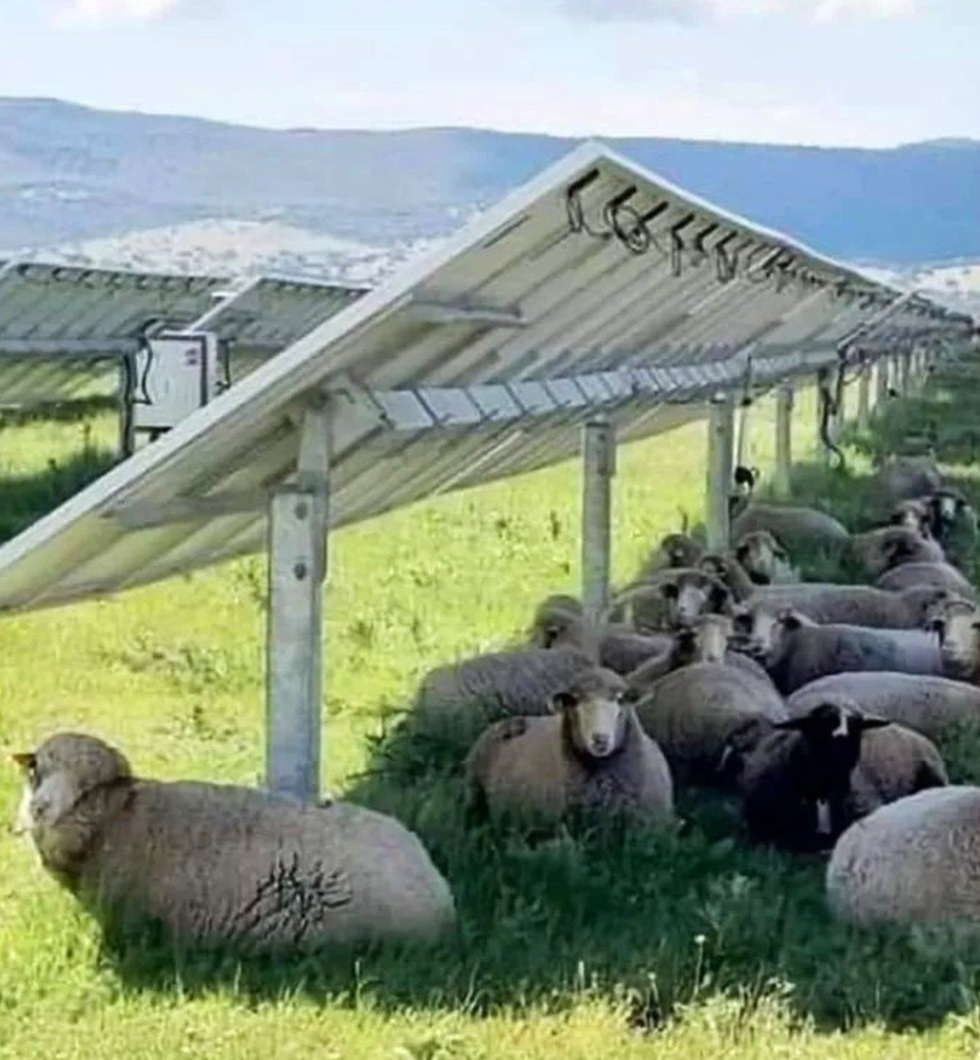
Solar energy double-decker on September 3, 2024: Above are the slanted solar panels - below the sheep in the shade [15]
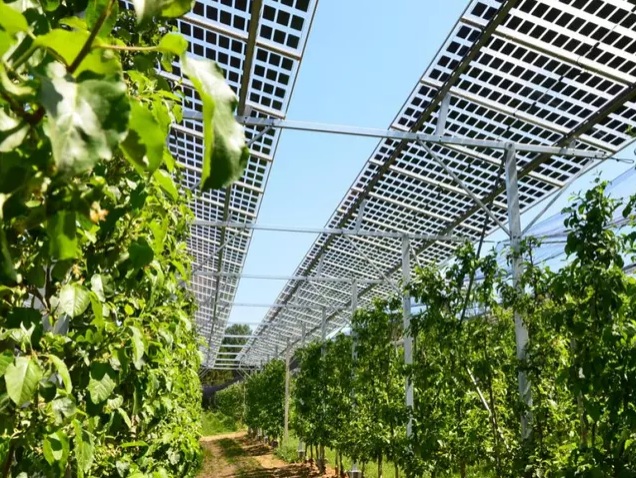
Haidegg (Styria, Austria) May 18, 2024: Solar panels protectomg fruit trees [14]
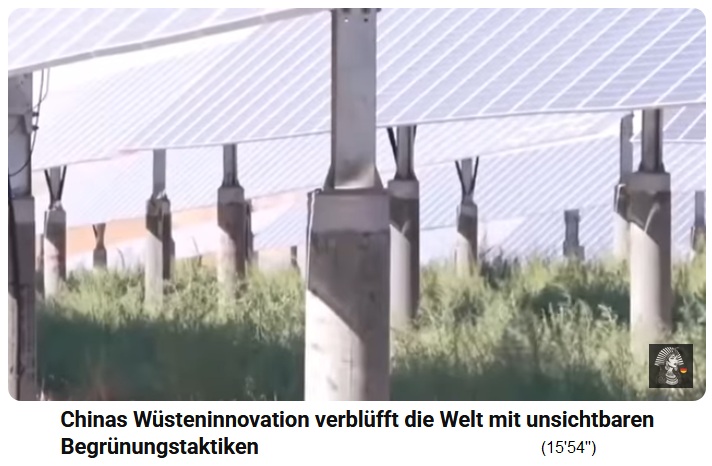
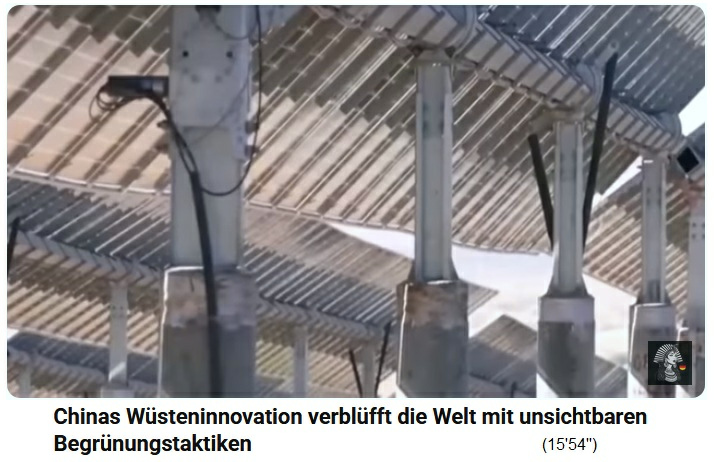
China Tibuki Desert: Solar collectors 3m high and cultivated fields on the ground [70,71]
Agrophotovoltaik (German): http://www.agrophotovoltaik.de/
Agro photovoltaics (ENGL): https://agri-pv.org/en/
Agro PV = Agro photovoltaics
Company for solar plants in Austria: Insolar - Pachfurtherstr 9 / 2465 Höflein / Österreich / https://insolar.at/
News
presented by Michael Palomino (translation 2025)
| Share: |
Facebook |
|
Twitter
X
|
|
|
|
The program:
-- Solar energy on the 2nd floor: Berlin / Heggelbach (BW) May 6, 2019: Farms with field solar power (agrophotovoltaics): Solar systems over the fields with shade-tolerant plants - dual use of the land - only the law is missing: Double harvest? Solar power and potatoes from the same field – new technology
-- Solar energy on the 2nd floor foldable against hail and snow: June 23, 2020: PARKING LOT=SUN POWER+solar protection of vehicles! Jakobsbad AI (Appenzell Innerrhoden): Unique folding roof provides shade for the parking lot and generates electricity
-- Solar energy on the 2nd floor above parking lots: THAILAND in Chonburi on Nov 5, 2020: The systematic solar parking lot: MG unveils the world's largest solar parking lot in Thailand
-- January 8, 2021: Installing solar systems over fields: Agrivoltaics: Electricity from the fields can cover 20 percent of electricity needs.
-- New Jersey June 25, 2023: Solar parking lot with electricity production and the cars are in the shade - University 'Rutgers University Livingston Campus'
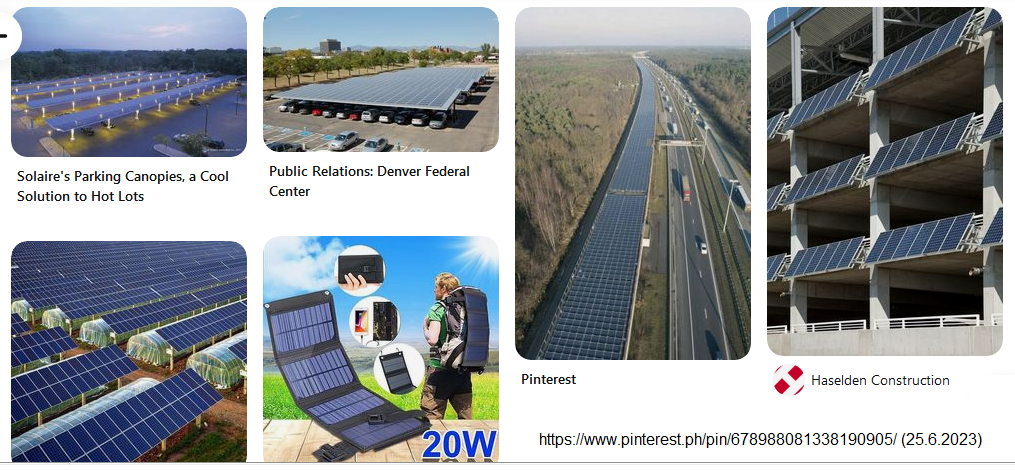
-- Collection photo on June 15, 2023: Solar collectors on the second floor: on platform roofs - as garage roofs - on highway galleries - above greenhouses - on balconies etc.
-- Denmark on Aug 3, 2023: Solar energy above a parking lot - simultaneously protects the vehicles
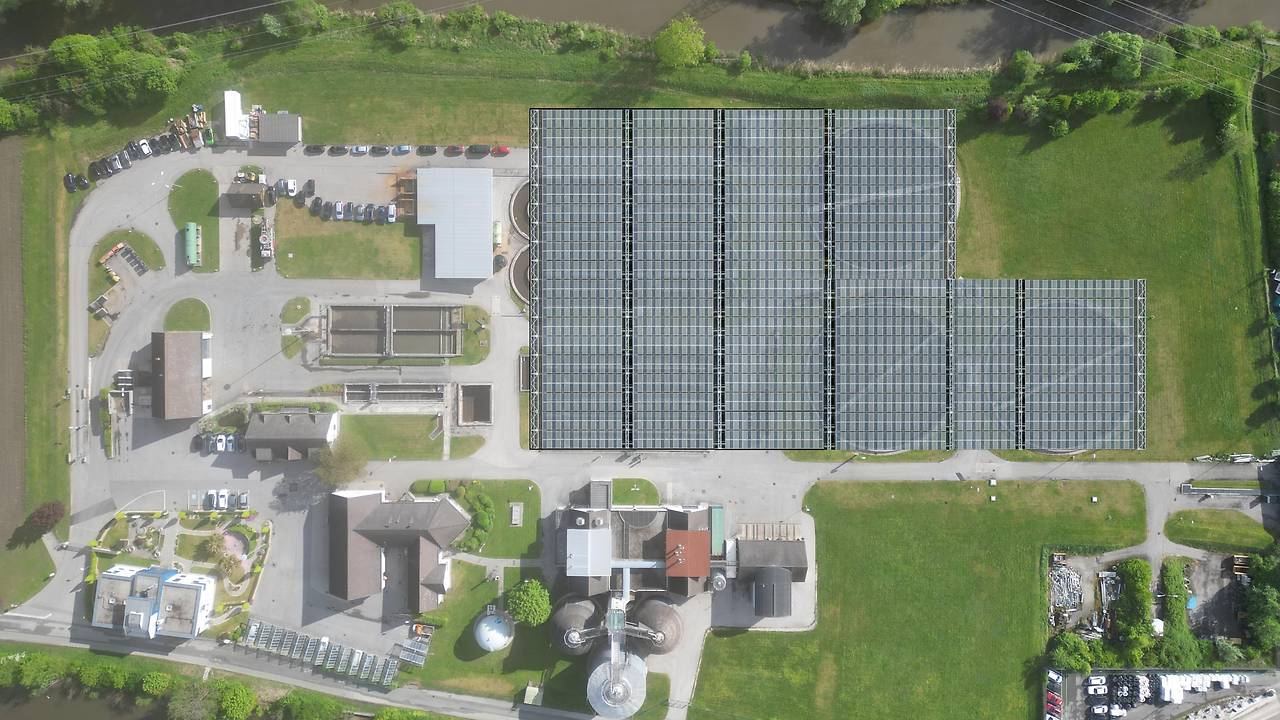
-- GRAZ (Austria) on April 27, 2024: Foldable solar roof is also protected against hail and snow: Foldable solar roof for wastewater facility Grazerfeld
-- Solar energy in Styria (Austria) on 18.5.2024: over fruit trees: PV systems protect orchards
-- same place: Dual function of solar energy in Haidegg (Styria, Austria) on May 18, 2024: also protects fruit trees: Photovoltaics over fruit cultivation protects against rain and frost: Photovoltaic panels over fruit crops not only produce electricity.
-- Solar energy in South Tyrol (Italy) on May 21, 2024: may now also be installed on agricultural land for "scientific purposes" - testing of plants in partial shade and without rain: Implementation regulations added: Agri-photovoltaics for scientific purposes allowed.
-- Solar energy double-decker on September 3, 2024: Above are the inclined solar panels (which automatically drip water) and below are the sheep in the shade
-- Solar collectors on the second floor in China on July 19, 2025: in the Tibuki desert - and asparagus grows in the shade: 6. Desert becomes pasture with solar collectors above - planting of asparagus in the shade is possible: China's desert innovation amazes the world with invisible greening tactics (23'30'') --
WARNING
-- Solar panels break with big hail - there is a lack of hail protection with chicken wire.
-- Snow is blocking the solar panels and a huge cleaning action is needed.
-- In zones without hail or snow there is not problem with that, BUT:
-- The recycling problem after 30 years of operation is NOT resolved
-- The best energy source is gas power plants: little damage during transport, NO waste, compost produces gas, and CO2 is NOT involved in climate change
-- Shading fields is a possible tactic for increasing yield.
Michael Palomino THE MOBILE PHONE IS NOT A BANK - Aug 19, 2025
The articles:
Solar energy on the 2nd floor:
Berlin / Heggelbach (BW) May 6, 2019: Farms with field solar power (agrophotovoltaics): Solar systems over the fields with shade-tolerant plants - dual use of the land - only the law is missing:
Double harvest? Solar power and potatoes from the same field – new technology
(orig. German: Doppelte Ernte? Solarstrom und Kartoffeln vom selben Feld – neue Technologie)https://de.sputniknews.com/wissen/20190506324890242-doppelte-ernte-solarstrom-und-kartoffeln-vom-selben-feld-neue-technologie/
Heggelbach Farm: Solar system built over a field with shadow plants, potatoes below, courtyard community Heggelbach (link German) in Herdwangen (BW, Germany - link) - Photo of the Fraunhofer Institute for Solar Energy Systems, Freiburg i.Br. [1]
Agro photovoltaics: http://www.agrophotovoltaik.de/ (German)
Summary:
Just install a solar system above a field so that the farmer can sell solar power, AND:
-- The shade plants grow even better and give 11% MORE yield
-- At the same time, 8% of the yield is lost due to the installation space
-- This results in an increase of 3% in the planted yield.
The plant species:
-- Shade tolerant plants are: potatoes, hops, spinach, ginseng, lettuce, field beans, legumes, some grape varieties, some fruits [and asparagus, see the video link ENGL - or the video minutes with photos link German]
-- Shady with some partial shade: onions, cucumbers, zucchini
-- Partial shade: cereals (rye, barley, oats), white cabbage, rapeseed, peas, asparagus, carrots, radish, leeks, celery, fennel
-- Sunny with some partial shade: beets, cauliflower, beetroot
-- Sunny: wheat, corn, millet, pumpkin, sunflowers, east, grapes, broccoli
Translation:
<Valentin Raskatov
Harvesting potatoes and collecting solar energy at the same time? What previously sounded like an either-or could change in agriculture in the future due to agrophotovoltaics APV (German: Agrophotovoltaik - APV). Fraunhofer ISE presented the technology in Berlin on Monday. Sputnik was on site.
Solar modules have so far only had a place in agriculture in "disadvantaged areas". Such areas are low-yielding and therefore non-economic land that farmers are allowed to use for other purposes. In the case of high-yield soils, on the other hand, the question of using it to generate solar power did not arise – food production clearly takes precedence here. But a new technology could change that. It is called agrophotovoltaics (APV) and is used in a number of countries, including France, Japan and China, and combines arable farming and the use of solar energy.
[Supplement: The hail protection is missing - vertical position at 90 degrees
There is no protection against hail - because then the solar panels break into small pieces, the ground becomes poisoned and full of shards, and the ground must be replaced. To prevent this, ONE can stretch chicken wire as protection over it, OR one can install pivoting solar panels that can be positioned vertically at a 90-degree angle during rain, OR one can fix the solar elements at a 90-degree angle and accept a 20% decrease in power output, but in exchange, has the assurance that neither hail nor snow can damage the solar elements, and that electricity is always produced also in winter when the snow never stays on the solar panels and no major cleaning efforts are necessary.]
The Fraunhofer Institute for Solar Energy Systems (ISE) [ISE in Freiburg i.Br., Baden-Württemberg (link Ge)] outlined the technology back in the 1980s, but only recently optimized it, demonstrating it in a pilot project at the Heggelbach community farm (link Ge) [Herdwangen, Baden-Württemberg (link Ge)] and presenting the results at a final conference (link Ge) on Monday in Berlin.
The technology is impressive, at least if you choose the right vegetables or fruits. For instance, in Heggelheim, the amount of potatoes could be increased by three percent compared to production without agrophotovoltaics (APV). The system harvested 86 percent of the solar energy compared to an area that would only be used as a solar park:
Heggelbach Farm: Setup: More yield plus 11%, minus 8% land loss, still results in a gain of 3% in soil yield [2]
[The solar panels protect the planting against hail - cultivation of sensitive varieties - but the solar elements also have to be protected!]
But not only potatoes are of interest here: “We believe that APV would have great advantages in the area of specialty crops because these are very valuable and are often protected by hail protection nets or shading films,” explains Stephan Schindele, project manager of APV-Resola (link Ge) at Fraunhofer ISE to Sputnik. The use in vineyard cultivation or strawberry farming is also conceivable. The researchers have developed a graph where “+” indicates the varieties where yield is increased, “0” indicates those where it remains the same, and “-” indicates where APV negatively affects yield:
Heggelbach Farm: Graphic with shadow plants (higher yield with solar collectors on top), semi-shadow plants (same yield), sun plants (lower yield) [3]
Asparragus is missing on the graphics: it's a shadow plant - (link German)
[Field solar power is 3 cents more expensive than from 'disadvantaged areas' - decentralized energy supply is guaranteed]
However, APV is not economically competitive with installations in 'disadvantaged areas', as the electricity generated by APV is almost 3 cents per kilowatt-hour more expensive. Currently, the technology can only compete with rooftop systems, according to Schindele. However, that may not be necessary, as APV becomes interesting when considering decentralized energy systems. Farmers can thus supply themselves with electricity, especially when it comes to processing harvested products. They could also use it to power electric tractors or autonomous agricultural robots in the future. Finally, they can easily supply excess electricity to nearby farms.
[Field solar power is IN - Wind power and biogas plants with fruit destruction are OUT]
The Heggelbach farmer Mr. Thomas Schmid is satisfied with this solution, and according to Schindele, the citizens of the region are developing an acceptance that is supposed to surpass that of wind power plants and biogas.
Heggelbach Farm: Graph of electricity usage 1) in the yard 2) in the village 3) feeding into the grid [4]
[The posts in the field - the distribution of rainwater]
One difficulty remains due to the posts that support the modules, through which the farmer's work in these places proceeds more slowly or more cautiously than before. On the other hand, a problem that existed with a predecessor system of the Weihenstephan-Triesdorf University of Applied Sciences from 2013 was solved: During rainfall, a large amount of precipitation fell on a line via the inclined modules. These areas silted up and bore no fruit.
To counteract this, the module plates were divided by a three-centimetre-wide gap and the height of the posts was raised to five metres. In this way, the water drains off in several places and can also be scattered even further by the wind as it flies to Earth.
[Water systems with water tanks possible]
However, another application does not allow this water to run away so uncontrollably. "In arid climates, we think that we could even collect water, then also have a water tank with cisterns and then irrigate with droplets," Schindele notes.
[One can install a shower system or sprinkler system].
[Payback after 5 years - service life 25 years]
After four to five years, such a system should pay for itself, and its service life should be 25 years. The question arises as to what will happen to all the old systems: "There is a PV cycle project (link German) at EU level for the solar modules, in which the solar industry has committed itself to taking back all solar modules. This is regulated by law, so how they are disposed of. With the steel construction, the steel still has a residual value even after the end of its life cycle, so you still get money if you take the steel scrap somewhere."
At present, however, there is still no legal regulation for the multiple use of fertile soils, because farmers were only allowed solar energy in "disadvantaged areas". In addition, subsidies would probably make sense to make the technology more attractive for farmers in addition to a possibility of decentralized energy supply.>
Links:
-- Agrophotovoltaik (German): http://www.agrophotovoltaik.de/
-- Agro photovoltaics (ENGL): https://agri-pv.org/en/
-- Fraunhofer Institute for Solar Energy Systems (ISE): ISE in Freiburg i.Br., Baden-Württemberg (link ENGL)
-- Heggelbach Farm Community
-- Construction of the solar system on the field of the Heggelbach farm community, photos - link (German)
-- the electricity production of the field solar power plant (agrophotovoltaics) - Link (German)
Daily history - Link (German) I Monthly course - Link (German) I Annual course - Link (German) I Year-on-year comparison (from 2016) - Link (German)
Comment
-- Solar panels break with big hail - there is a lack of hail protection with chicken wire.
-- Snow is blocking the solar panels and a huge cleaning action is needed.
-- In zones without hail or snow there is not problem with that, BUT:
-- The recycling problem after 30 years of operation is NOT resolved
-- The best energy source is gas power plants: little damage during transport, NO waste, compost produces gas, and CO2 is NOT involved in climate change
-- Shading fields is a possible tactic for increasing yield.
Michael Palomino THE MOBILE PHONE IS NOT A BANK - Aug 19, 2025
Solar energy on the 2nd floor foldable against hail and snow:
June 23, 2020: PARKING LOT=SUN POWER+solar protection of vehicles!
Jakobsbad AI (Appenzell Innerrhoden): Unique folding roof provides shade for the parking lot and generates electricity.
(orig. ENGL: Jakobsbad AI (Appenzell Innerrhoden): Einzigartiges Faltdach spendet Parkplatz Schatten und liefert Strom)
https://www.20min.ch/story/einzigartiges-faltdach-spendet-parkplatz-schatten-und-liefert-strom-326542301107
Foldable solar panels built over a parking lot, Jakobsbad in Appenzell Innerrhoden (Switzerland) [5]
- <Two birds with one stone: The new solar folding roof at the Kronberg cable car in Jakobsbad AI produces electricity while also providing shade.
- The photovoltaic system can generate electricity for 70 households.
- The project costs about 1.5 million francs.
A new kind of photovoltaic folding roof was put into operation on Monday above a parking lot at the Jakobsbad-Kronberg cable car in AI. It is expected to produce power that meets the electricity needs of 70 households.
The solar folding roof is said to be unique in the world and sends a strong signal for the energy transition in Eastern Switzerland, according to the project announcement on Monday. The facility is a joint venture of the Jakobsbad-Kronberg cable car company and the St. Gallen-Appenzell power plants AG (SAK). Here you can see the folding roof 'in action':
After about 13 months of construction, the solar folding roof was put into operation on Monday. Fully deployed, it provides shade for 152 passenger cars in the parking lot. The roof consists of 1,320 solar panels distributed over an area of 4,000 square meters. It will produce 350,000 kilowatt-hours of solar power annually in the future. (SDA)(SDA)>
Comment
-- With a folding solar roof there is not problem with that, BUT:
-- The recycling problem after 30 years of operation is NOT resolved
-- The best energy source is gas power plants: little damage during transport, NO waste, compost produces gas, and CO2 is NOT involved in climate change
-- Shading parkings for vehicles are possible tactic for increasing level of life with vehicles.
Michael Palomino THE MOBILE PHONE IS NOT A BANK - Aug 19, 2025
Solar energy on the 2nd floor above parking lots:
THAILAND in Chonburi on Nov 5, 2020: The systematic solar parking lot:
MG unveils the world's largest solar parking lot in Thailand
(orig. German: MG enthüllt den weltweit größten Solarparkplatz in Thailand)
https://www.wochenblitz.com/index.php/home/wochenblitz/2013-09-11-06-57-19/item/7777-mg-enthuellt-den-weltweit-groessten-solarparkplatz-in-thailand
Solar parking lot in Thailand Chonburi, 5.11.2020 - every parking space can become a solar power plant and the vehicles are in the shadow [6]
Comment
-- In zones without hail or snow there is not problem with that, BUT:
-- The recycling problem after 30 years of operation is NOT resolved
-- The best energy source is gas power plants: little damage during transport, NO waste, compost produces gas, and CO2 is NOT involved in climate change
-- Shading parkings is a possible tactic for increasing level of life with vehicles.
Michael Palomino THE MOBILE PHONE IS NOT A BANK - Aug 19, 2025
January 8, 2021: Installing solar systems over fields:
Agrivoltaics: Electricity from the fields can cover 20 percent of electricity needs.
https://www.epochtimes.de/umwelt/erneuerbare-energie/agrivoltaik-strom-vom-feld-kann-20-prozent-des-strombedarfs-decken-a3418967.html
im Internet-Archiv:
https://web.archive.org/web/20210108082648/https://www.epochtimes.de/umwelt/erneuerbare-energie/agrivoltaik-strom-vom-feld-kann-20-prozent-des-strombedarfs-decken-a3418967.html
Almost 40 years ago, German farmers and engineers were already thinking about combining power generation and agriculture. So far, German building law has hindered large-scale implementation. In the USA, the concept of agrivoltaics could now set a precedent and create long-term "green" energy, profits and jobs.
"More food, more energy, lower water requirements, lower carbon emissions, and more prosperous rural communities," says Chad Higgins, associate professor in Oregon State University's College of Agricultural Sciences, summarizing the latest research. He is not talking about utopian simulation games, but about agrivoltaics. Agrivoltaics, or agrophotovoltaics, is the combination of agriculture and photovoltaics, or simply put: solar power from the field.
With an investment of less than one percent of the annual US budget, the researchers write in a study (link ENGL) published at the end of 2020, this combination could cover 20 percent of the total electricity demand of the USA. In addition, the large-scale installation of agrivoltaics systems leads to an annual CO2 saving of 330,000 tons and could create almost 120,000 jobs, especially in rural regions, without significantly affecting crop yields.
Agriculture is not the problem, but part of the solution
Agriculture consumes an enormous amount of resources, Professor Higgins calculates (link ENGL). 85 percent of the world's water consumption goes to irrigation and more than a third of all greenhouse gases are attributed to agriculture. Both could improve agrivoltaics.
"Rural America, especially agriculture, can be the solution to many of our problems (link ENGL)," Professor Higgins continued. Both "renewable energy, mitigating the effects of climate change, sustainable food or good management of water resources" would benefit. Nevertheless, this potential usually remains unused "because not enough investment has been made in [suitable locations]".
What we propose in this study is all possible. It is technically possible. It is politically possible. And it would bring in money after the initial investment. That's the bottom line – and that we should look at agriculture as a solution to problems and not as the cause of the problems."
Although the idea of agrivoltaics was developed in Germany almost 40 years ago, agrivoltaics systems seem undesirable in this country. Under the leadership of the Fraunhofer Institute for Solar Energy Systems (Fraunhofer ISE), a field on Lake Constance was covered with solar panels as early as 2016. Contrary to expectations, the yields of some crops under the plant increased compared to the neighboring reference area (report). Driving on agricultural machinery also proved to be surprisingly easy.
[This is the solar plant on a field in Heggelbach (German) see above - link (German)].
Legally, the test field is not a field, but a commercial area, because according to German building law, commercial solar systems are only allowed to be operated on commercial areas. However, subsidized agriculture (link German) is not allowed to take place on these areas, which leads project manager Stephan Schindele from ISE to conclude: We could already be much further along, but politics is preventing it.
In the "USA", a five-hectare plant is to be built in the city of Aurora, 30 kilometers south of Portland, Oregon, in 2021 and convince the agricultural community and potential donors. Ultimately, according to the researchers, about 33,700 square kilometers – or about one percent of the U.S. agricultural land – could be covered with solar cells. The electricity generated in this way corresponds to about 20 percent of current US electricity generation (link German).
"Green" profits and jobs for 20 to 35 years
Installation and maintenance would cost 1.12 trillion dollars (about 913 billion euros) over an expected service life of 35 years. The researchers expect the amortization after 17 years. By the end of the 35 years, solar plants could generate a further 35.7 billion dollars (about 29 billion euros) in revenue.
The installation will also lead to the creation of 117,000 jobs over a period of 20 years. About 40 percent of this was accounted for by "sustainable positions for operation and maintenance," according to the researchers.
Looking to the future, Higgins believes that the large-scale installation of agrivoltaic systems "opens the door to other technologies." For example, the (excess) energy generated could be used to power electric tractors (link German) or to produce fertilizer on a farm. Sensors installed on the substructures could determine growth and nutrient content and thus optimize agricultural production. "Once we have the infrastructure, once we have energy, we are ready to tackle so many more big problems," Professor Higgins said confidently.
Comment
-- Solar panels break with big hail - there is a lack of hail protection with chicken wire.
-- Snow is blocking the solar panels and a huge cleaning action is needed.
-- In zones without hail or snow there is not problem with that, BUT:
-- The recycling problem after 30 years of operation is NOT resolved
-- The best energy source is gas power plants: little damage during transport, NO waste, compost produces gas, and CO2 is NOT involved in climate change
-- Shading fields is a possible tactic for increasing yield.
Michael Palomino THE MOBILE PHONE IS NOT A BANK - Aug 19, 2025
New Jersey June 25, 2023: Solar parking lot with electricity production and the cars are in the shade - University 'Rutgers University Livingston Campus'
https://www.facebook.com/photo?fbid=10228289278924767&set=a.2261743670725
Pinterest with link to Ecowatch: https://www.pinterest.ph/pin/678988081338190905/
FB China: https://www.facebook.com/permalink.php?story_fbid=2270329999958731&id=1924546047870463
EcoWatch: Internet Archives: https://web.archive.org/web/20150315102919/https://www.ecowatch.com/2014/11/26/universities-invest-renewable-energy/
Google Earth: link
google maps: link
New Jersey Rutgers University - Nov 26, 2014: 3 Reasons Universities Are Investing in Renewable Energy
June 25, 2023: Solar parking lot in New Jersey at Rutgers University [7] - Map with Google Maps [10]

New Jersey Rutgers University, aerial view of the solar parking lot with Google Earth [8] - side view [9]
https://www.ecowatch.com/2014/11/26/universities-invest-renewable-energy/
in the Internet Archives: https://web.archive.org/web/20150315102919/https://www.ecowatch.com/2014/11/26/universities-invest-renewable-energy/
Colleges and universities have always been focal points of change. The mixture of academic research, student activism and institutional clout has allowed campus communities to promote widespread technical and social transformations. During the last few years, a few of these institutions have begun to lead in an entirely new area—renewable energy. Just last September, the University of California system announced an 80 megawatt (MW) procurement contract for off-site solar photovoltaic (PV) electricity, enough to power almost 13,000 homes
While this is the largest power purchase agreement (PPA) on record for a university, it was not the first. Back in 2008, the University of Oklahoma signed an agreement with Oklahoma Gas & Electric to purchase 100 percent renewable electricity, spurring the development of a 44-turbine wind farm [wind energy is harming A LOT, this is NO future]. Then, in 2012, Ohio State University signed a 20-year PPA for 50 MW of wind power [wind power is damaging a LOT and is NOT the future]. This year, George Washington University and American University teamed up, along with George Washington University Hospital, to secure 52 MW of solar PV from Duke Energy Renewables. Meanwhile, many campuses have installed significant on-site resources. Three universities in particular—Arizona State, Rutgers and Mount Saint Mary’s—have installed more than 57 MW of solar PV combined; enough to power more than 9,000 U.S. homes. [...]
Comment
-- Solar panels break with big hail - there is a lack of hail protection with chicken wire.
-- Snow is blocking the solar panels and a huge cleaning action is needed.
-- In zones without hail or snow there is not problem with that, BUT:
-- The recycling problem after 30 years of operation is NOT resolved
-- The best energy source is gas power plants: little damage during transport, NO waste, compost produces gas, and CO2 is NOT involved in climate change
-- Shading parking lots is a possible tactic for increasing the standard of life with vehicles.
Michael Palomino THE MOBILE PHONE IS NOT A BANK - Aug 19, 2025
Collection photo on June 15, 2023: Solar collectors on the second floor: on platform roofs - as garage roofs - on highway galleries - above greenhouses - on balconies, etc.
https://www.pinterest.ph/pin/678988081338190905/
Solar systems on the second floor on June 25, 2023: Options - collection photo [16]
Comment
-- Solar panels break with big hail - there is a lack of hail protection with chicken wire.
-- Snow is blocking the solar panels and a huge cleaning action is needed.
-- In zones without hail or snow there is not problem with that, BUT:
-- The recycling problem after 30 years of operation is NOT resolved
-- The best energy source is gas power plants: little damage during transport, NO waste, compost produces gas, and CO2 is NOT involved in climate change
-- Shading fields or parking lots, etc. is a possible tactic for increasing yield or standard of living.
Michael Palomino THE MOBILE PHONE IS NOT A BANK - Aug 19, 2025
Denmark on Aug 3, 2023: Solar energy above a parking lot - simultaneously protects the vehicles
https://www.facebook.com/Britta.Inkognito/posts/6556154604467191
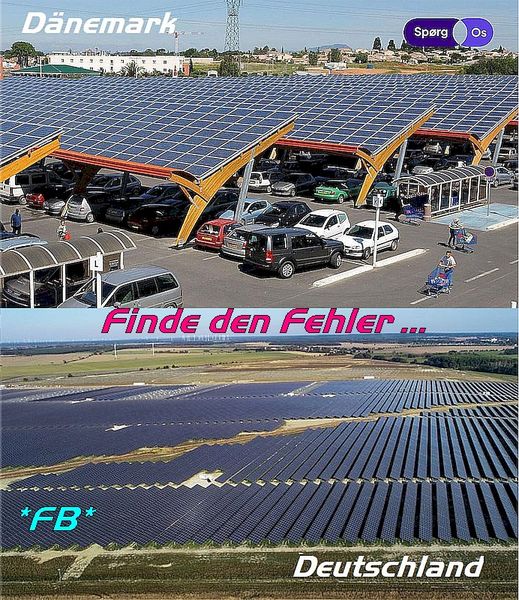
Denmark: Solar energy over a car park - Germany is stupid installing the solar panels directly on the ground destroying the ground [11]
Comment
-- Solar panels break with big hail - there is a lack of hail protection with chicken wire.
-- Snow is blocking the solar panels and a huge cleaning action is needed.
-- In zones without hail or snow there is not problem with that, BUT:
-- The recycling problem after 30 years of operation is NOT resolved
-- The best energy source is gas power plants: little damage during transport, NO waste, compost produces gas, and CO2 is NOT involved in climate change
-- Shading parking lots is a possible tactic for increasing the standard of living with vehicles.
Michael Palomino THE MOBILE PHONE IS NOT A BANK - Aug 19, 2025
GRAZ (Austria) on April 27, 2024: Foldable solar roof is also protected against hail and snow:
Foldable solar roof for wastewater facility Grazerfeld
(orig. German: Faltbares Solardach für Abwasseranlage Grazerfeld)
https://steiermark.orf.at/stories/3254334/
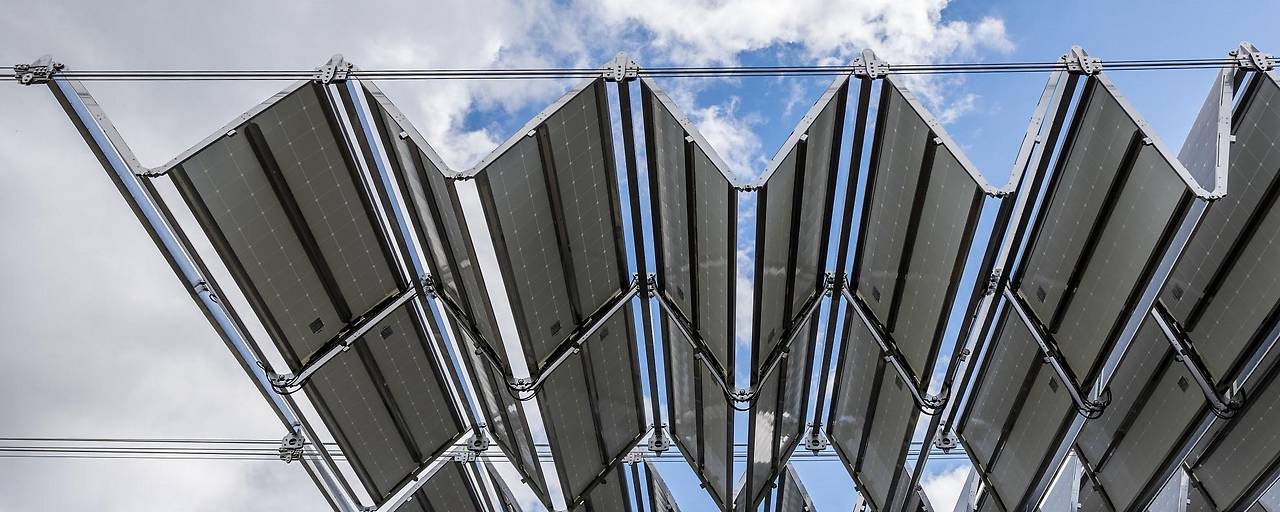
GRAZ (Austria) on April 27, 2024: The foldable solar roof is also protected against hail and snow, view from below [12] and from above [13]
An innovative solar technology from Switzerland, which is making its debut in Austria, will help the Graz wastewater association to become energy self-sufficient. To this end, 5.4 million euros will be invested in a foldable solar system.
Solar system can be retracted at night, during storms or hail
Andreas Philadelphy, the deputy managing director of the Graz wastewater association, explains why they chose this variant of a solar roof: "The special feature is that during adverse weather conditions – that is, during strong winds, hail, and at night when there is no production – the solar panels can be retracted fully automatically."
The solar folding roof can also be retracted manually, for example during repair work – allowing activities to be carried out on the wastewater treatment plant below.
Unique in Austria
In Switzerland, there are already 17 similarly equipped facilities, but this is the first of its kind in Austria, according to Michael Lechner, managing director of the Grazerfeld sewage association. The good experiences from Switzerland have been an important argument for this type of solar installation. Another reason is an upcoming EU regulation which states that wastewater treatment plants serving 100,000 residents or more must become energy self-sufficient by 2040.
13 member municipalities in the south of Graz between Feldkirchen and Wundschuh will benefit from the solar facility starting in the second quarter of 2025: By then, the wastewater treatment plant in Wildon will be equipped with the folding solar roof and will ideally produce 4,500 kilowatt-hours of electricity daily.
red, steiermark.ORF.at
Comment
-- Solar panels break with big hail - there is a lack of hail protection with chicken wire.
-- Snow is blocking the solar panels and a huge cleaning action is needed.
-- In zones without hail or snow there is not problem with that, BUT:
-- The recycling problem after 30 years of operation is NOT resolved
-- The best energy source is gas power plants: little damage during transport, NO waste, compost produces gas, and CO2 is NOT involved in climate change
-- Shading a zone is a possible tactic for increasing standard of life.
Michael Palomino THE MOBILE PHONE IS NOT A BANK - Aug 19, 2025
Solar energy in Styria (Austria) on 18.5.2024: over fruit trees:
PV systems protect orchards
(orig. German: PV-Anlagen schützen Obstplantagen)
https://steiermark.orf.at/stories/3257584/
Weather extremes such as hail, heat, frost or dry periods have caused enormous crop failures in fruit growing in recent years. In order to protect the fruit, fruit growers are currently expecting a lot from photovoltaic systems that cover orchards. Initial attempts are promising.
The system has been tested for two years at the Haidegg test facility for fruit and viticulture in the province of Styria. The first results are now available. On around 5,000 square metres in the east of Graz, seven types of fruit grow under more than 1,100 photovoltaic modules. At the same time, the same fruit species are grown in the open air – sometimes under hail nets. This should make it easier to compare yield, quality and plant health with and without panels.
After the late frost in April, the first data is now available: In the stone fruit rows without a roof, brown, dried leaves and hardly any fruit were to be found in mid-May. The trees under the solar cells were significantly larger. They have already borne some small fruit, confirms the head of the station, Leonhard Steinbauer. "Photovoltaics ensures that the trees remain healthier and grow longer in autumn."
Hail bounces "like billiard ball"
The PV roofs not only protect against frost, but also against rain. This, in turn, reduces the susceptibility to fungi and chemical preservatives can be dispensed with, according to Haidegg's consistently positive experience. Hail remains a challenge, according to the station manager: "The grains bounced off the PV modules like a pool table and flew into the next row onto the plants."
[And if there are large hailstones, the solar panels break, poison and splinter the ground and you have to replace the entire soil].
The research will be continued and will be expanded. A financing commitment from the province of Styria is already on the table. "The first focus of photovoltaics remains on pre-polluted surfaces such as roofs, parking lots or roads," says Franz Grießer, head of the Department of Agriculture and Forestry of the Province of Styria. "With Agri-PV, however, we can secure ourselves not only in terms of food, but also in terms of energy," he emphasizes.
red, steiermark.ORF.at/Agenturen
same place:
Dual function of solar energy in Haidegg (Styria, Austria) on May 18, 2024: also protects fruit trees:
Photovoltaics over fruit cultivation protects against rain and frost: Photovoltaic panels over fruit crops not only produce electricity.
(orig. German: Photovoltaik über Obstbau schützt vor Regen und Frost: Photovoltaik-Paneele über Obstkulturen produzieren nicht nur Strom)
https://www.suedtirolnews.it/wirtschaft/photovoltaik-ueber-obstbau-schuetzt-vor-regen-und-frost
Company in Austria: Ecowind solar projects link (German)
Dual function of solar energy in Haidegg (Styria, Austria) May 18, 2024: solar panels are also protecting fruit trees against rain and snow: photovoltaic panels above fruit crops not only produce electricity [14]
Photovoltaic panels over fruit crops not only produce electricity but also provide plants with protection from frost and rain. This was demonstrated by initial results from the experimental station for fruit and viticulture in Haidegg, Styria, which has been testing an Agri-PV system for two years. "Climate change brings more of everything – hail, heat, frost, dry periods," said Leonhard Steinbauer, head of the station. The areas are simultaneously used for food and energy production.
Apples, cherries, apricots, plums – around 5,000 square meters in eastern Graz host seven types of fruit under 1,134 photovoltaic modules. These are 49 percent light-permeable, resulting in a slightly lower performance. To compare the effects of the PV system on yield, fruit quality, and plant health, the same fruit varieties were also grown in open air, some under hail nets. After the late frost in April, it is now evident: In the stone fruit rows without protection. In the stone fruit rows without a roof, by mid-May there are brown, withered leaves and hardly any fruits to be found. The espalier trees under the solar panels were significantly larger, and they had already borne some small fruits.
"The photovoltaic system ensures that the trees remain healthier and grow for a longer time in autumn," explained Steinbauer. It has been shown that those under the PV setup produced more and higher quality flower buds. It is too early to say how well the modules could protect against frost in April: "One doesn't know what has happened in the fruit tissue. But it currently looks spectacularly better," Steinbauer expressed optimism. In any case, it has already been noted that it is about 0.25 degrees Celsius warmer under the PV system. This is due to the carport effect - similar to cars under a cover, the temperature under the panels is slightly higher.
Thanks to the PV roof, the fruit crops are also protected from rain. Data from Haidegg shows that the duration of leaf wetness per day under the modules is significantly shorter. Thus, one can do without chemical protective agents against fungi, as are also used in organic farming. "If the leaves are wet, that is ideal for the scab fungus, for example. It can destroy entire harvests," said Steinbauer. The panels are arranged in rows over the plants. Rainwater flows in between, running down from the slope towards the trees.
Hail is, according to Steinbauer, one of the challenges: 'The hailstones bounced off the PV panels like on a billiard table and flew into the next row onto the plants.' Nets between the rows could provide additional protection. 'And the real mildew feels very comfortable here.' Now, solutions against this fungal disease, which attacks dry leaves, are to be developed.
'Our primary focus for photovoltaics remains on previously used areas like roofs, parking lots, or roads,' said Franz Grießer, head of the Agriculture and Forestry Department of the State of Styria. 'However, through Agri-PV, we can secure not only food but also energy,' he emphasized. With energy production, a second source of income emerges for farmers.
The facility, funded by the federal and state government, produces about 385,000 kilowatt-hours of electricity per year, which is primarily used on-site in Haidegg. It was built by the company Ecowind and commissioned in June 2022. Research will continue in the coming years, with a sustainable bio-strategy to be developed. Funding for an expansion of the facility has already been secured by the state of Styria, said Steinbauer. Agri-PV is not suitable for all fruit farmers, as suitable infrastructure such as lines is needed.
Von: apa
Comment
-- Solar panels break with big hail - there is a lack of hail protection with chicken wire.
-- Snow is blocking the solar panels and a huge cleaning action is needed.
-- In zones without hail or snow there is not problem with that, BUT:
-- The recycling problem after 30 years of operation is NOT resolved
-- The best energy source is gas power plants: little damage during transport, NO waste, compost produces gas, and CO2 is NOT involved in climate change
-- Shading fields is a possible tactic for increasing yield.
Michael Palomino THE MOBILE PHONE IS NOT A BANK - Aug 19, 2025
Solar energy in South Tyrol (Italy) on May 21, 2024: may now also be installed on agricultural land for "scientific purposes" - testing of plants in partial shade and without rain:
Implementation regulations added: Agri-photovoltaics for scientific purposes allowed.
(orig. German: Durchführungsbestimmungen ergänzt: Agri-Photovoltaik für wissenschaftliche Zwecke erlaubt)
https://www.suedtirolnews.it/politik/agri-photovoltaik-fuer-wissenschaftliche-zwecke-erlaubt
Translation:
Bolzano – Agricultural photovoltaic systems are now permitted for research purposes on state-owned agricultural land: The state government has amended the applicable implementation regulations.
The implementation regulation on the use of energy from renewable sources (Decree of the Governor No. 13/2020) stipulates in which cases facilities for generating energy from renewable sources can be constructed without specific land designation. It includes, among other things, provisions for the installation of photovoltaic panels and thermal solar collectors.
In its meeting today, the state government approved, on the proposal of the State Council for Energy Peter Brunner, an amendment to the regulation: This consists of allowing the implementation of pilot projects for agri-photovoltaic systems on state-owned lands in agricultural areas for scientific purposes.
"With this, we enable the realization of agri-photovoltaic test facilities on state-owned lands for research," explains State Councilor Peter Brunner. "We are taking an important step towards the generation of renewable energy through agri-photovoltaic systems, which are currently not legally permitted." The state decree, which defines suitable areas for agri-photovoltaics, is in development, Brunner reports. "After its issuance, general solutions for the entire state area can be sought. Until then, pilot projects on state-owned lands for research purposes are permitted due to this change," explains the State Councilor (Landrat).
In agrivoltaics, also known as agro or agricultural photovoltaics, agricultural production and electricity generation are combined on the same area.
The Council of the Municipalities has given its consent to the amendment of the regulation.
from: luk
Comment
-- Solar panels break with big hail - there is a lack of hail protection with chicken wire.
-- Snow is blocking the solar panels and a huge cleaning action is needed.
-- In zones without hail or snow there is not problem with that, BUT:
-- The recycling problem after 30 years of operation is NOT resolved
-- The best energy source is gas power plants: little damage during transport, NO waste, compost produces gas, and CO2 is NOT involved in climate change
-- Shading fields is a possible tactic for increasing yield.
Michael Palomino THE MOBILE PHONE IS NOT A BANK - Aug 19, 2025
Solar energy double-decker on September 3, 2024: Above are the inclined solar panels (which automatically drip water) and below are the sheep in the shade
von Chris Smith auf Facebook: https://www.facebook.com/photo/?fbid=915033603998548
Solar energy double-decker on September 3, 2024: Above are the inclined solar panels (which automatically drip water)
and below are the sheep in the shade [15]
Comment
-- Solar panels break with big hail - there is a lack of hail protection with chicken wire.
-- Snow is blocking the solar panels and a huge cleaning action is needed.
-- In zones without hail or snow there is not problem with that, BUT:
-- The recycling problem after 30 years of operation is NOT resolved
-- The best energy source is gas power plants: little damage during transport, NO waste, compost produces gas, and CO2 is NOT involved in climate change
-- Shading fields is a possible tactic for increasing yield.
Michael Palomino THE MOBILE PHONE IS NOT A BANK - Aug 19, 2025
Solar collectors on the second floor in China on July 19, 2025: in the Tibuki desert - and asparagus grows in the shade:
6. Desert becomes pasture with solar collectors above - planting of asparagus in the shade is possible:
China's desert innovation amazes the world with invisible greening tactics (23'30'')
(orig. German: Chinas Wüsteninnovation verblüfft die Welt mit unsichtbaren Begrünungstaktiken (23'30'')
https://www.youtube.com/watch?v=dLB5BYureS8 - YouTube channel: Das Tagebuch von Kleopatra - uploaded on July 19, 2025
China Tibuki Desert: Solar panels 3m high and field crops on the ground [70,71]
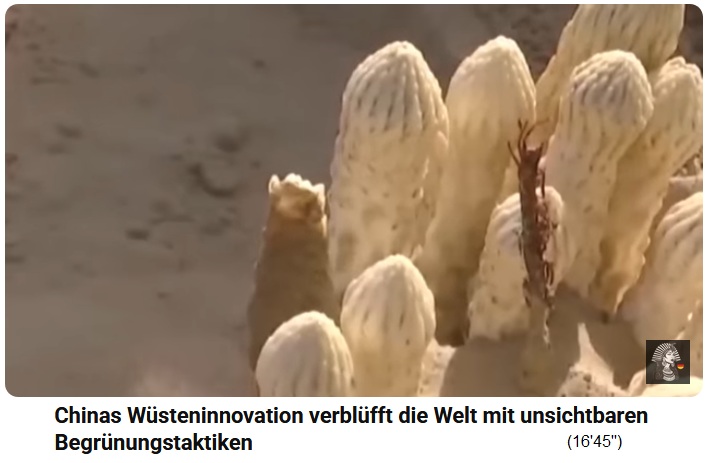
China Tibuki Desert: Asparagus grows under the solar panels [73]
Comment
-- There is no hail problem and no snow problem in the desert, BUT:
-- The recycling problem after 30 years of operation is UNsolved
-- The best energy source is gas power plants: little damage during transport, NO waste, compost produces gas, and CO2 is NOT involved in climate change
-- Shading the converted desert is a possible tactic to increase yield.
Michael Palomino THE MOBILE PHONE IS NOT A BANK - Aug 19, 2025